Switch From Gas to Electric Vehicle in Everett, WA
A step-by-step 2026 guide to switching from a gas car to an EV in Everett, WA — home charging, WA incentives, range planning, and registration fees.
Switching from a gas car to an electric vehicle in Washington State in 2026 comes down to five decisions: choosing the right EV for your driving pattern, setting up home charging, understanding what remains of Washington's tax incentives, budgeting for state EV registration fees, and mapping the public charging you'll actually use., so the financial math for Everett buyers looks different than it did a year ago — but the transition itself is more straightforward than most first-time EV buyers expect.
This guide walks through the process in the order it actually happens, with the Washington-specific rules that matter for a buyer in Snohomish County.
What is the first step to switch from a gas car to an EV in Washington State?
The first step is auditing your daily driving pattern before you shop. Track your typical weekday mileage for one to two weeks, note where you park overnight, and confirm whether you can install a 240-volt outlet at home. For most Everett commuters — whether driving to Boeing, downtown Seattle, or across Snohomish County — a battery EV with 200+ miles of range and Level 2 home charging covers 95% of trips without public charging.
This audit matters more than any spec sheet. A driver in the Silver Lake or Mukilteo area with a garage and a 30-mile daily commute has a fundamentally different EV shopping list than a renter parked on-street in downtown Everett. Nissan of Everett's sales team routinely walks first-time EV buyers through this evaluation before pointing them at a specific model, because the wrong match — too little range, no home charging plan — is the single biggest reason gas-to-EV switchers become dissatisfied.
Key inputs to gather before shopping
- Average daily and weekly miles driven
- Overnight parking situation (garage, driveway, street, apartment lot)
- Distance and frequency of longer trips (Bellingham, Portland, the passes)
- Household second-vehicle status (gas backup for road trips changes the math)
- Utility provider — Snohomish County PUD serves most Everett addresses
How do Washington State EV incentives work for buyers in 2026?
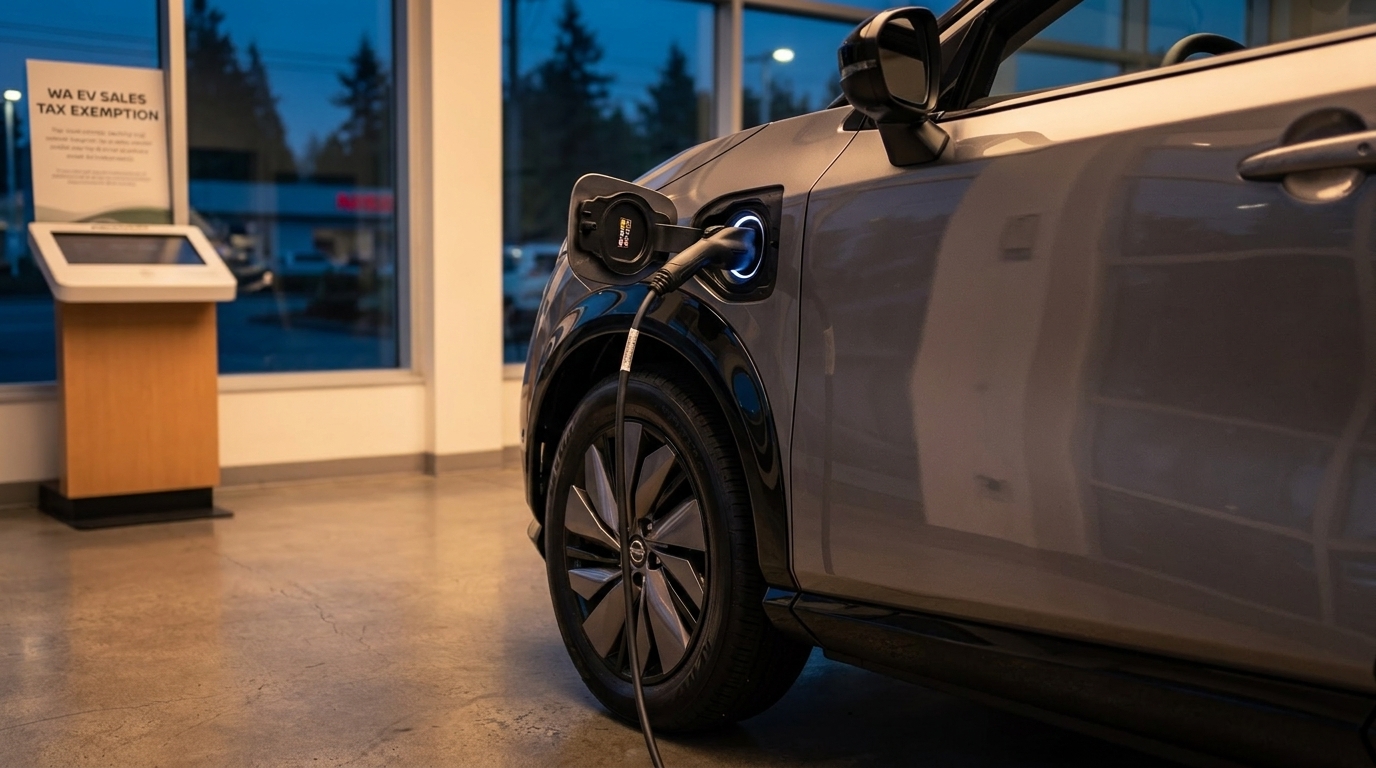
. That exemption had capped eligibility at $45,000 MSRP for new vehicles and $30,000 for used, and dealers applied it at the point of sale. A narrower exemption under RCW 82.08.9999 continues for fuel-cell electric vehicles through July 31, 2028, but battery EV and plug-in hybrid buyers no longer receive the state sales tax break at purchase.
What remains for Everett buyers is a patchwork rather than a single statewide rebate. Utility-level programs — administered by individual utilities under their own tariffs — can offer rebates on Level 2 chargers, wiring upgrades, or off-peak charging credits. Eligibility typically requires being a current customer, submitting receipts, and meeting installation or vehicle-registration conditions. Buyers should contact their utility directly to confirm current program availability and funding status before assuming a rebate is available.
Washington EV incentive snapshot
| Incentive | Status in 2026 | Governing Rule |
|---|---|---|
| Sales/use tax exemption on battery EVs and PHEVs | Expired for vehicles delivered after July 31, 2026 | RCW 82.08.809 / 82.12.809 |
| Sales/use tax exemption on fuel-cell EVs | Available through July 31, 2028 | RCW 82.08.9999 |
| Utility rebates (chargers, wiring, off-peak) | Program-specific; varies by utility | Individual utility tariffs |
| Annual battery EV fee & Transportation Electrification Fee | Ongoing — owed annually at registration | Title 46 RCW |
Battery EV owners in Washington also owe separate annual registration fees — a battery EV fee and a Transportation Electrification Fee — administered under Title 46 RCW. These are distinct from purchase-tax incentives and should be factored into the total cost of ownership from year one.
How does home charging setup work for a first-time EV buyer in Everett?
Home charging setup involves three steps: confirming your electrical panel has capacity for a 240-volt Level 2 circuit, hiring a licensed Washington electrician to install a dedicated 40- or 50-amp circuit near your parking spot, and pulling any required City of Everett or Snohomish County electrical permits. Most single-family homes in the Everett area can accommodate Level 2 charging without a service upgrade; older homes with 100-amp panels sometimes need a load calculation.
A Level 2 charger adds roughly 25 to 35 miles of range per hour of charging — enough to fully replenish a typical commute overnight on Snohomish County PUD's residential rates. Level 1 charging (a standard 120-volt outlet) works as a backup or for plug-in hybrids but is generally too slow to serve as the only charging solution for a battery EV driven daily.
Renters and condo owners in downtown Everett or along the waterfront face a different challenge. Options include negotiating a shared Level 2 install with a landlord, relying on nearby public DC fast chargers, or considering a plug-in hybrid as a bridge vehicle until home charging becomes feasible.
What does Washington's EV charging infrastructure look like outside the home?
Washington has one of the more mature public charging networks on the West Coast, anchored by the I-5 corridor that runs directly through Everett. DC fast chargers are clustered near I-5 exits, shopping centers, and along the U.S. 2 route toward Stevens Pass — relevant for anyone using an EV for weekend trips to the Cascades. For daily driving, most Everett EV owners rarely touch public charging; it becomes the story on road trips.
For trips to Portland, Vancouver BC, or over the passes, buyers should plan the first year of ownership around the fast-charging networks their specific vehicle supports (CCS, NACS via adapter, or Tesla Supercharger access depending on model). Range anxiety typically resolves within the first two months of ownership once drivers see how their actual routine maps to available charging.
Which Nissan EV options make sense for first-time switchers in Everett?
Nissan's EV lineup gives first-time switchers two distinct paths: the LEAF as an established, lower-cost commuter EV, and the Ariya as a longer-range crossover for households replacing a primary vehicle. Both are sold and serviced at Nissan of Everett, which matters because Washington's cool, wet climate has minimal impact on battery health compared to hot-climate states, but service familiarity with EV-specific systems still varies dealer to dealer.
For an Everett buyer replacing a gas commuter and keeping a second vehicle for road trips, a LEAF's range is usually sufficient and its lower entry price offsets the loss of the state sales tax exemption. For a household going all-electric or wanting a single vehicle that handles Cascade trips comfortably, the Ariya's longer range is the more defensible choice. Nissan of Everett's sales team is known for patient, informative sales conversations — the kind of interaction first-time EV shoppers benefit from most.
What should Everett buyers budget for the total switch?
Budget for four line items beyond the vehicle itself: a Level 2 home charger (hardware plus installation), any required electrical permit through the City of Everett or Snohomish County, Washington's annual battery EV registration fees under Title 46 RCW, and. Fuel and maintenance savings typically offset these over the ownership period, but the upfront picture is different than it was under the old exemption.
Buyers comparing a gas vehicle to an EV should model at least three years of ownership, not just the sticker price. Electricity per mile in Snohomish County PUD territory is meaningfully cheaper than gasoline, and EVs eliminate oil changes and most brake wear — offsets that compound over time.
Frequently asked questions
Is there still a Washington State sales tax exemption on electric vehicles in 2026?
Not for battery EVs or plug-in hybrids.. A narrower exemption for fuel-cell electric vehicles under RCW 82.08.9999 continues through July 31, 2028, subject to vehicle-type and price eligibility. Utility-level rebates on chargers and installations remain available through individual utility programs.
What annual fees do EV owners pay in Washington State?
Battery electric vehicle owners in Washington pay separate annual registration fees under Title 46 RCW, including a battery EV fee and a Transportation Electrification Fee. These are administered by the Department of Licensing and are distinct from any purchase-tax incentive. They apply every year at registration renewal and should be factored into total cost of ownership from year one.
How much range do I actually need for daily driving in Everett?
Most Everett drivers can meet their needs with 200 or more miles of EPA-rated range. A typical commute from Everett to Seattle and back is roughly 60 miles, well within the range of any current battery EV. Higher range becomes important if the vehicle is the household's only car, if the driver frequently crosses the Cascades, or if home charging is limited to Level 1.
Can I charge an EV in an Everett apartment or condo?
It depends on the property. Some Everett apartment and condo complexes have installed shared Level 2 stations; others have not. Renters without dedicated charging can rely on nearby public DC fast chargers, workplace charging if available, or choose a plug-in hybrid that can be topped up on a standard 120-volt outlet. Confirm charging access before committing to a battery EV in a shared-parking situation.
Does Washington's rainy climate hurt EV battery life?
Not meaningfully. EV batteries degrade fastest in sustained high heat, which is why hot-climate states see more accelerated wear. Western Washington's cool, wet climate is close to ideal for long-term battery health. Cold snaps below freezing temporarily reduce range on any EV, but the effect is short-lived and does not cause permanent capacity loss.
Should I buy new or used for my first EV?
Both work, but the tradeoffs shifted in 2026. With, the previous $45,000 new / $30,000 used price caps no longer gate the decision. New EVs come with full factory warranties and current battery chemistry; used EVs offer lower entry cost but require careful battery health verification. First-time buyers often benefit from a certified pre-owned or new purchase for the warranty coverage.
Making the switch in Everett
The gas-to-EV transition in Washington is fundamentally an exercise in matching a vehicle to a driving pattern, setting up home charging correctly, and budgeting honestly for what the state's current tax and fee structure actually looks like in 2026., but the operational case for switching — lower fuel and maintenance costs, mature public charging along I-5, a climate that treats batteries well — remains intact.
Readers in Everett who want the switch handled by a dealer familiar with Nissan's EV lineup, Washington's registration rules, and the practical realities of home charging setup can reach Nissan of Everett at https://www.nissanofeverett.com to start the conversation.