Complete Auto Financing Guide for Washington State Residents
A practical guide to auto financing in Washington State — covering loan types, credit requirements, rates, and how to get the best deal in Everett in 2026.

Complete Auto Financing Guide for Washington State Residents
Buying a car is one of the larger financial decisions most people make, and figuring out how to pay for it can feel just as complicated as choosing the vehicle itself. If you live in Everett or the surrounding area and you're trying to make sense of car loans in Washington, this guide breaks down what you actually need to know — from how lenders evaluate your application to what rates look like in 2026.
Whether you're purchasing your first vehicle or trading up to something newer, understanding vehicle financing before you walk into a dealership puts you in a significantly stronger position.
How Auto Financing Works in Washington State
Auto financing is essentially a secured loan. You borrow money to purchase a vehicle, and the vehicle itself serves as collateral. If you stop making payments, the lender can repossess the car. That structure is why auto loan rates tend to be lower than unsecured personal loans — the lender has less risk.
In Washington State, auto loans are available through several channels:
- Dealership financing — The dealership works with a network of lenders and presents you with loan options directly. This is often the most convenient route, especially if you're buying and financing in the same visit.
- Credit unions — Washington has a strong credit union presence, and members often access competitive rates. You'll need to apply separately and bring approval to the dealership.
- Banks — Traditional banks offer auto loans, though rates can vary widely depending on your relationship with the institution.
- Online lenders — A growing segment that can offer competitive rates, particularly for buyers with strong credit profiles.
Most buyers in Everett use dealership financing because it simplifies the process — one visit, multiple lender options, and often access to manufacturer-backed financing programs with promotional rates.
Auto Loan Rates in Washington State: What to Expect in 2026
Auto loan rates in 2026 vary based on your credit score, loan term, vehicle age, and the lender you work with. Buyers with strong credit (typically 720 and above) generally qualify for the most competitive rates on new vehicles. Rates climb as credit scores decrease, and they're also typically higher on used vehicles than new ones.
Loan terms commonly range from 36 to 84 months. Longer terms lower your monthly payment but increase the total interest you pay over the life of the loan. Nissan of Everett notes that most loan terms fall between 48 and 72 months — a range that often hits the right balance for most buyers, keeping payments manageable while limiting overall interest accumulation.
Washington State does not cap auto loan interest rates for most consumer vehicle purchases, so the rate you receive is determined by the lender and your creditworthiness. Shopping multiple lenders — or working with a dealership that has access to many of them — gives you the best chance of landing a competitive offer.
Credit Requirements for Car Loans in Washington
Your credit score is the single biggest factor lenders use to set your rate, but it's not the only one. Here's how lenders typically evaluate auto loan applications:
Credit Score Tiers
- 720 and above (Prime/Super Prime): You'll generally qualify for the best available rates and have your pick of loan terms.
- 660–719 (Near Prime): Solid options are available, though rates will be modestly higher than top-tier borrowers.
- 600–659 (Subprime): Financing is available but at higher rates. A larger down payment can improve your offer.
- Below 600 (Deep Subprime): Some lenders specialize in this range. Expect higher rates and potentially stricter loan terms. A co-signer with stronger credit can help.
Other Factors Lenders Evaluate
- Debt-to-income ratio (DTI): Lenders want to know your existing debt obligations relative to your income. A lower DTI signals you can comfortably handle another payment.
- Employment history: Stable, consistent employment is a positive signal. Self-employed buyers may need to provide additional documentation.
- Down payment: Putting money down reduces your loan-to-value ratio, which lowers lender risk and can improve your rate. Nissan of Everett also offers financing with no down payment in most cases and can roll taxes, registration, and fees into the financing deal — contact them for current details.
- Vehicle age and mileage: Newer vehicles with lower mileage are less risky for lenders, which often translates to better financing terms.
Getting Pre-Approved: Why It Matters
Getting pre-approved for a car loan before you shop is one of the most practical things you can do as a buyer. Pre-approval gives you a clear budget, shows sellers you're a serious buyer, and gives you a benchmark to compare against any financing offers you receive at the dealership.
The process is straightforward. Most lenders — including dealership finance departments — can run a pre-approval with a soft credit pull that doesn't affect your score. You'll typically need to provide proof of income, proof of residence, a valid ID, and your Social Security number.
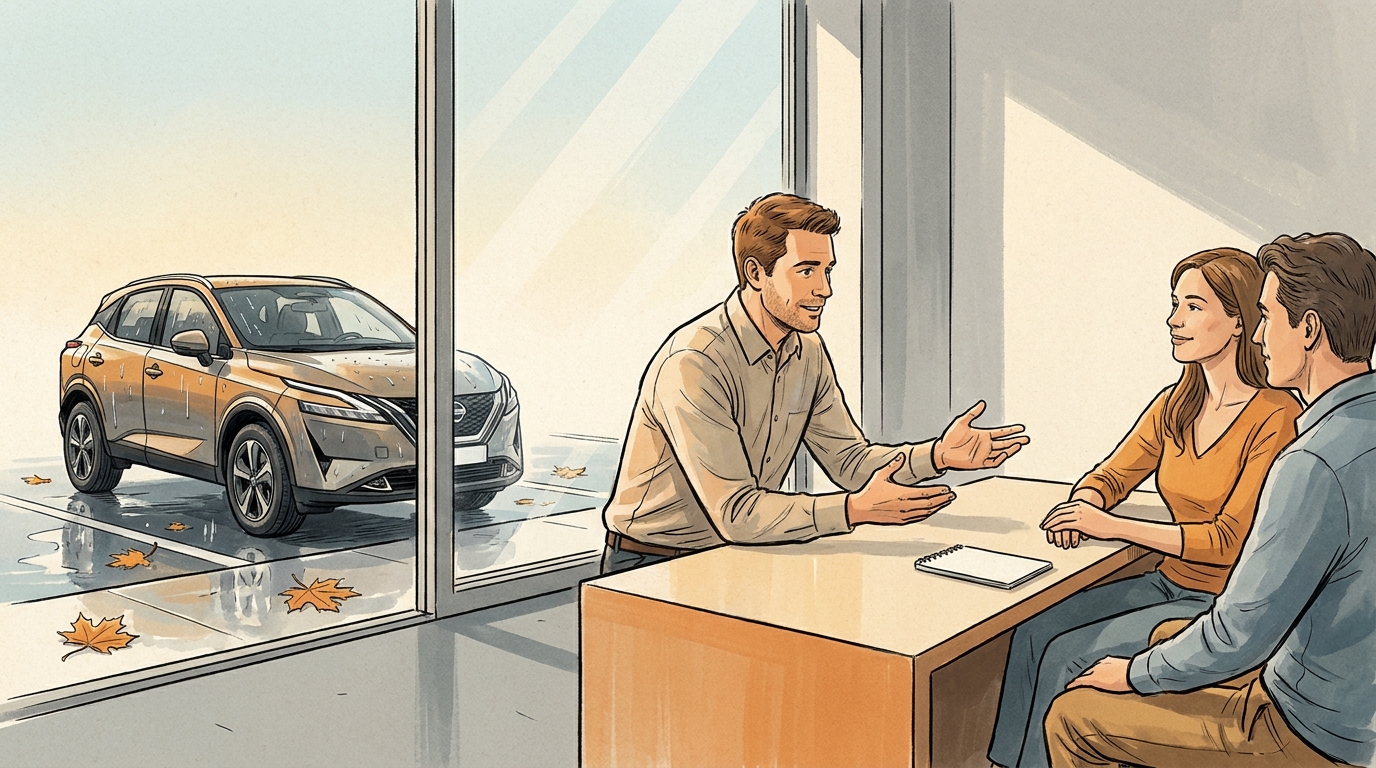
At Nissan of Everett, the finance team works with a number of financial institutions and banks throughout the Edmonds and Marysville, WA area, which means buyers across a range of credit situations can typically find a workable path to financing. One customer described the experience: their salesperson "listened to what we had to say, understood our goals, and met us in the middle with options that fit our needs." That kind of approach is what separates a productive financing conversation from a frustrating one.
Washington State Sales Tax and Fees on Vehicle Purchases
When calculating your total loan amount, don't forget to account for Washington State's sales tax on vehicle purchases. Washington applies sales tax to the full purchase price of a vehicle, and the rate varies slightly by county. In Snohomish County, where Everett is located, buyers should budget for both state and local tax on top of the vehicle price.
Additional costs to factor in include:
- Title and registration fees
- Documentation fees (charged by the dealership)
- Optional products like extended warranties or GAP insurance, which can be rolled into the loan
Understanding the full out-the-door cost before signing any paperwork helps you avoid surprises and keeps your loan amount — and monthly payment — where you expect it to be.
Frequently Asked Questions About Auto Financing in Washington State
Can I get a car loan in Washington with bad credit?
Yes. Several lenders specifically work with buyers who have limited or damaged credit histories. Your rate will be higher, and you may face stricter terms, but financing is often available. A larger down payment and a co-signer can meaningfully improve your options. Some dealerships — including those with dedicated finance teams — have relationships with lenders who specialize in non-prime lending.
What's the difference between getting financed at a dealership vs. a bank?
A bank or credit union gives you a single offer based on their own criteria. A dealership finance department submits your application to multiple lenders simultaneously and presents you with the best available options. For many buyers, this produces a more competitive result without additional legwork. The key is working with a dealership finance team that's transparent about the terms — not one that buries fees in the monthly payment.
How much should I put down on a car in 2026?
A common guideline is to put down as much as you can comfortably afford. Putting more down reduces your monthly payment, lowers your interest costs, and protects you from being underwater on the loan (owing more than the car is worth) if the vehicle depreciates faster than you pay it off. That said, many buyers finance with less — especially when promotional financing rates are available on new vehicles.
Does getting pre-approved hurt my credit score?
A soft inquiry — used during pre-qualification — does not affect your credit score. If you move forward with a formal application, the lender will run a hard inquiry, which can lower your score by a few points temporarily. If you're shopping multiple lenders within a short window, those inquiries are usually treated as a single event.
What is GAP insurance and do I need it?
GAP (Guaranteed Asset Protection) insurance covers the difference between what you owe on your loan and what your vehicle is worth if it's totaled or stolen. Because new vehicles depreciate quickly — sometimes faster than you pay down the loan — GAP can protect you from owing money on a car you no longer have. It's especially worth considering if you put less than 20% down or are financing a longer-term loan.
Are there special financing programs for first-time buyers in Washington?
Yes. Several manufacturers offer first-time buyer programs that allow buyers without an established credit history to qualify for financing, sometimes with a co-signer or proof of steady income. Some manufacturers offer programs designed specifically for buyers with limited credit history. Ask the finance department at Nissan of Everett about current eligibility requirements when you visit.
Can taxes, registration, and fees be rolled into my auto loan in Washington?
In many cases, yes. Nissan of Everett offers the option to roll taxes, registration, and fees directly into your financing, which reduces what you need to bring to the table at signing. This can be particularly helpful for buyers who want to preserve cash for other expenses. Contact Nissan of Everett to confirm how this applies to your specific purchase and credit situation.
How do I know if a dealership's financing offer is competitive?
The best way is to get pre-approved through a bank or credit union before you visit, so you have a baseline rate to compare against. A transparent dealership finance team will welcome the comparison. If the dealership has access to multiple lenders — as Nissan of Everett does — they may be able to match or beat an outside offer, particularly on new vehicles with manufacturer-backed financing programs.
Practical Tips Before You Finance
- Check your credit report first. You're entitled to a free report from each bureau annually. Errors on your report can drag your score down unfairly — dispute them before you apply.
- Know your budget before your rate. Decide what monthly payment you can comfortably afford, then use that to work backward to a loan amount. Don't let a low monthly payment distract you from a high total cost driven by a long loan term.
- Compare total loan cost, not just monthly payment. A lower monthly payment stretched over a longer term can add significantly more interest over the life of the loan compared to a shorter term.
- Read the loan agreement carefully. Confirm the rate, term, total amount financed, and whether there are prepayment penalties before you sign.
Conclusion
Auto financing in Washington State follows the same fundamental mechanics as anywhere in the country, but local factors — county sales tax rates, regional lender availability, and manufacturer programs — shape the details in ways that are worth understanding before you buy. The buyers who get the best outcomes are generally the ones who arrive prepared: they know their credit score, have a realistic budget, and understand what they're agreeing to before they sign.
If you're in the Everett area and want to work through your financing options with a team that will walk you through the numbers clearly, Nissan of Everett's finance department is a practical starting point. They hold a 4.4-star rating from more than 1,000 Google reviews as of April 2026, reflecting consistent feedback about respectful, professional treatment — and that matters when you're navigating what can be a complicated process. Contact Nissan of Everett at (425) 347-5763 or visit www.nissanofeverett.com to explore your options.