Car Lease vs Buy Calculator: Which Option Saves Money in Everett
Use our lease vs buy calculator guide to decide which vehicle financing option saves you more money in Everett. Compare costs, benefits, and key trade-offs.

Car Lease vs Buy Calculator: Which Option Saves Money in Everett
You've found the vehicle you want. Now comes the question that trips up nearly every car shopper: should you lease it or buy it outright? The math looks straightforward on paper, but the right answer depends on how you drive, what you value, and what you plan to do with the vehicle two, five, or ten years from now.
This guide breaks down the real financial difference between leasing and buying, walks you through how to use a lease vs buy calculator effectively, and helps you figure out which option actually makes sense for your situation in Everett.
What a Lease vs Buy Calculator Actually Measures
A lease vs buy calculator compares the total cost of each option over a set period — typically three to five years. It factors in monthly payments, down payment, interest or money factor, depreciation, insurance differences, taxes, and residual value if you buy.
Most online calculators ask for the following inputs:
- Vehicle purchase price (MSRP or negotiated price)
- Down payment or cap cost reduction for a lease
- Loan interest rate or lease money factor
- Loan term (months)
- Lease term and residual value percentage
- Annual mileage estimate
- Your state's sales tax rate
The calculator outputs total cost of ownership for each path. But numbers alone don't tell the full story. You need to pair the calculator output with a clear picture of your actual driving habits and financial goals.
Breaking Down the Real Cost of Leasing
What You're Actually Paying For
When you lease, you're paying for the vehicle's depreciation during the lease term — not the full purchase price. If a car costs $35,000 new and is worth $22,000 after three years, you're financing roughly $13,000 worth of depreciation, plus interest (called the money factor) and fees.
This is why monthly lease payments are almost always lower than loan payments for the same vehicle. You're covering a fraction of the car's value, not all of it.
The Hidden Costs Leases Carry
Leasing has real advantages, but it also carries costs that don't always show up in the monthly payment:
- Mileage overage fees: Most leases cap annual mileage at 10,000 to 15,000 miles. In 2026, overage charges typically run $0.15 to $0.30 per mile. If you commute regularly in and around Everett, those miles add up fast.
- Wear and tear charges: Dents, interior damage, or worn tires beyond normal use can generate end-of-lease fees.
- Gap in equity: You build no equity in a leased vehicle. At lease end, you hand the car back and start over — with no trade-in value to apply toward your next vehicle.
- Disposition fee: Most leases charge a fee (often $300–$500) when you return the vehicle and don't re-lease or purchase it.
Breaking Down the Real Cost of Buying
The Long-Term Math on Ownership
Buying a vehicle — whether with cash or a loan — means you own an asset that retains residual value. As of 2026, the average new vehicle depreciates roughly 15–20% in the first year and continues declining, but after five or six years, depreciation slows significantly. At that point, a paid-off vehicle delivers real financial relief: no monthly payment, and a trade-in or resale asset when you're ready to move on.
Over a ten-year horizon, buying almost always wins on total cost — assuming you keep the vehicle long enough to reach the paid-off phase.
Where Buying Costs More Up Front
The trade-off is liquidity. Buying requires a larger down payment, higher monthly payments during the loan term, and the full sales tax burden upfront (in most states, including Washington). You're also fully responsible for maintenance costs beyond the warranty period.
If you're financing at a high interest rate, the cost advantage of buying shrinks. Current 2026 auto loan rates vary significantly by credit profile — this is where the calculator earns its value. Plug in your actual rate and compare.
Car Lease Benefits Worth Considering
Leasing isn't a financial mistake — it's a different tool. Here's where it genuinely makes sense:
- You drive under 12,000 miles per year. Low-mileage drivers rarely trigger overage fees and benefit from lower monthly costs.
- You want a new vehicle every two to three years. Leasing is structurally built for people who prefer driving the latest model with updated safety technology and features.
- You want predictable maintenance costs. Leased vehicles are almost always under the manufacturer's warranty for the full lease term, reducing surprise repair bills.
- You run a business. Lease payments are often partially deductible as a business expense — consult a tax professional for your specific situation.
For many Everett drivers who want a reliable daily commuter without a long-term commitment, leasing a well-equipped vehicle like a Nissan Altima or Nissan Rogue can deliver genuine monthly savings while keeping you in a current, warranty-covered vehicle.
Vehicle Financing Options: How to Compare Them Honestly
Side-by-Side Snapshot (Example: $35,000 Vehicle)
The numbers below are illustrative, not guaranteed — use them as a framework, then run your actual numbers through a calculator with your specific rate and terms.
- 36-Month Lease: ~$450/month, $2,000 cap cost reduction, total out-of-pocket over 3 years: ~$18,200. No asset at end.
- 60-Month Loan (at 6.5% APR): ~$683/month, $3,500 down, total out-of-pocket over 5 years: ~$44,580. Vehicle worth approximately $16,000–$18,000 at end of term.
- Net cost of ownership (buy): ~$26,000–$28,000 after factoring in resale value.
In this scenario, buying costs more monthly but less overall — especially if you keep the vehicle past the loan payoff date. Leasing delivers lower monthly exposure but zero equity return.
The Lease-or-Purchase Decision Comes Down to These Questions
- How many miles do you drive annually?
- How long do you plan to keep the vehicle?
- Is a lower monthly payment a financial necessity or a preference?
- Do you want flexibility to switch vehicles frequently, or stability?
- What's your credit score, and what rate can you qualify for?
If you answer "high mileage, long-term ownership, and building equity matters" — buying is almost certainly the better financial path. If you answer "low mileage, prefer new cars every few years, and lower monthly costs matter more" — leasing deserves serious consideration.
Frequently Asked Questions
Is leasing ever cheaper than buying over the long run?
Rarely, over a ten-plus year horizon. But over a three-to-five year window, leasing can be cheaper in total out-of-pocket costs, especially if you factor in avoided repair costs and the fact that you're not carrying depreciation risk on an aging vehicle.
Can I use a lease vs buy calculator for used vehicles?
Leasing used vehicles is possible but uncommon for most consumers. Lease vs buy calculators are primarily designed for new vehicle comparisons. For used vehicles, the calculation typically becomes a straightforward loan vs cash comparison.
What is a money factor in a lease, and how does it affect cost?
The money factor is the lease equivalent of an interest rate. Multiply it by 2,400 to convert it to an approximate APR. A money factor of 0.00200 equals roughly 4.8% APR. Negotiating a lower money factor — or taking advantage of manufacturer-supported lease programs — can meaningfully reduce your total lease cost.
Does it make sense to put more money down on a lease?
Generally, financial advisors caution against large down payments on leases. If the vehicle is totaled or stolen early in the lease, you may not recover that upfront payment. Putting less down and keeping cash liquid is typically the more financially sound approach.
Are there lease vs buy calculators available online?
Yes — several reputable automotive research sites offer free lease vs buy calculators. Edmunds, NerdWallet, and Bankrate all provide tools that let you input your specific figures. The most useful calculators include residual value estimates and allow you to adjust mileage assumptions.
How does my credit score affect whether leasing or buying is the better deal?
Your credit score directly shapes the interest rate or money factor you qualify for, which changes the cost comparison significantly. Strong credit typically unlocks manufacturer lease programs with competitive money factors, making leasing more attractive. Weaker credit tends to raise both loan APRs and lease money factors — run the calculator with your actual qualified rate before assuming one option is cheaper.
What happens if I want to exit a lease early in Everett?
Early lease termination is generally expensive. You may owe remaining payments, an early termination fee, and depreciation charges. Alternatives include transferring the lease to another driver through a lease-swap service or purchasing the vehicle at the residual value. Either way, exiting early almost always costs more than completing the lease term — factor that risk in before signing.
Making the Right Call for Everett Drivers
The honest answer is that neither leasing nor buying is universally better — the right choice depends on your specific financial picture. What the calculator does is remove guesswork and replace gut feeling with actual numbers tied to your life, not a hypothetical average driver.
Everett drivers who put heavy miles on their vehicles — commuting to Seattle, running regional errands, or using their vehicle for work — typically find that buying delivers better value. Drivers who prefer always being in a current model with predictable costs and flexibility often find leasing a genuinely smart fit.
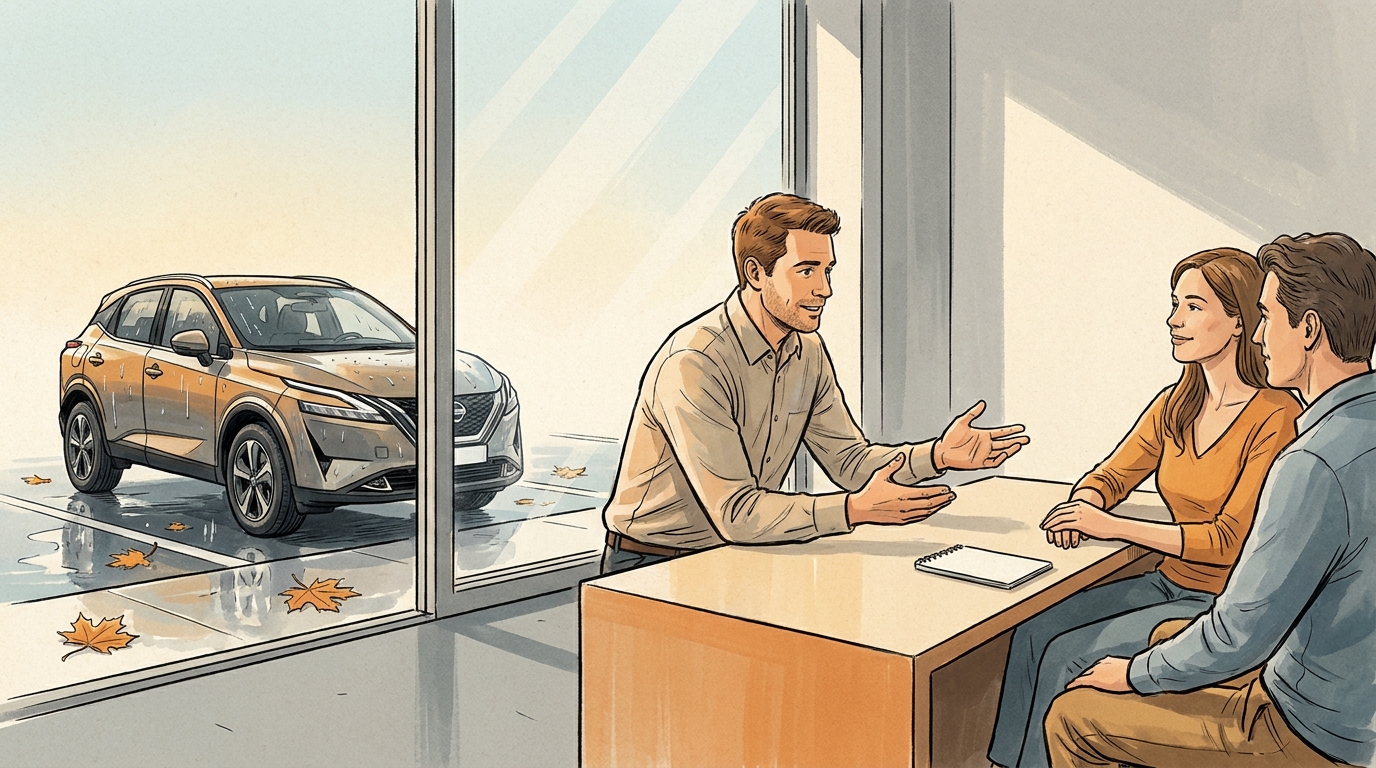
One customer who worked with Nissan of Everett described the experience in detail, writing that the salesperson "listened to what we had to say, understood our goals, and met us in the middle with options that fit our needs." That kind of conversation — grounded in your actual situation rather than pushing one product — is what makes a complex financial decision manageable.
Nissan of Everett holds a 4.4★ rating across more than 1,071 Google reviews, with customers regularly noting that the experience felt respectful and transparent rather than high-pressure.
Drivers in Everett who want help running the numbers on a specific vehicle — and understanding what lease or loan terms they'd actually qualify for — can connect with the team at Nissan of Everett at www.nissanofeverett.com. It's a useful first step before signing anything.