Nissan Check Engine Light: What to Do in Redmond, WA
A Nissan check engine light in Redmond, WA? Learn what triggers it, when to keep driving, when to pull over, and how to get an accurate diagnosis.
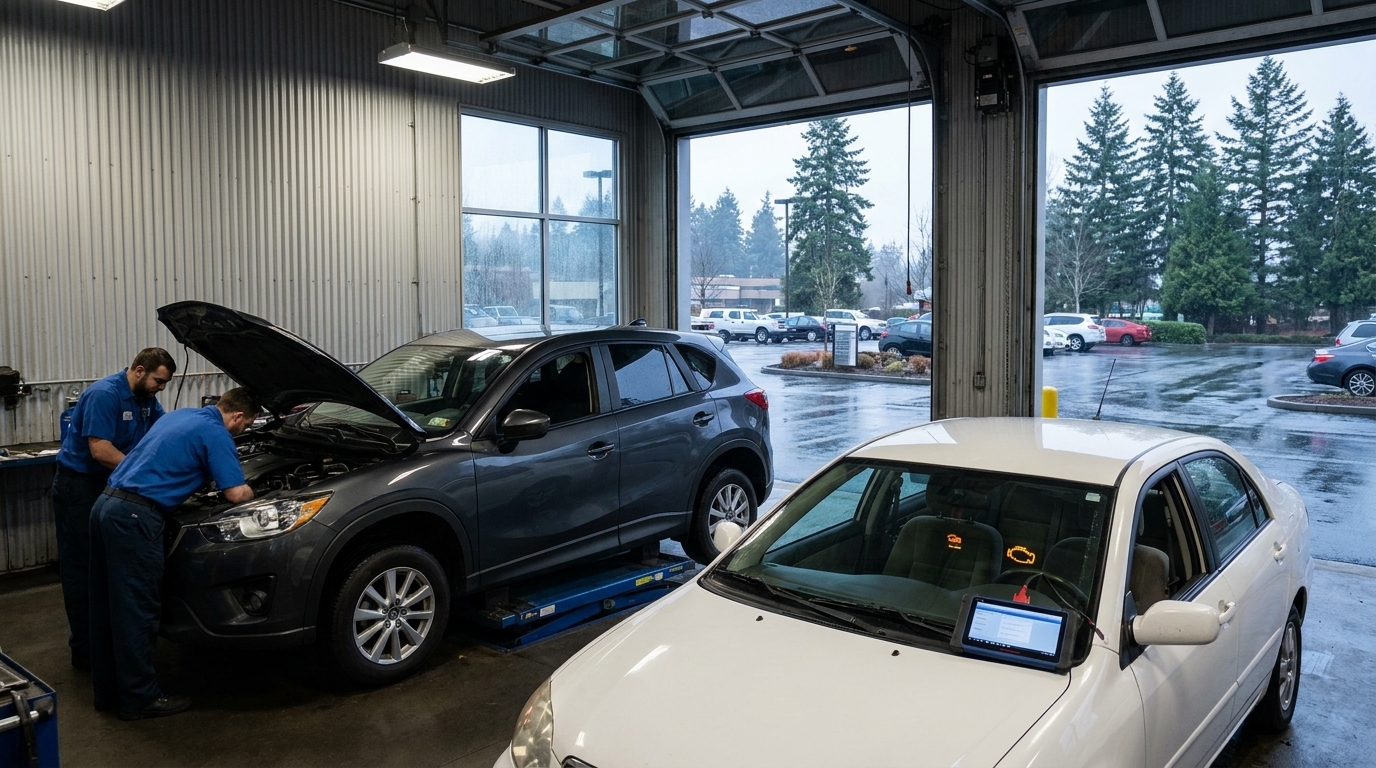
When a Nissan check engine light comes on, the first thing to do is note whether it is solid or flashing. A solid light means a fault has been logged and the vehicle needs diagnosis soon; a flashing light means an active misfire is occurring and the car should be driven as little as possible before it is inspected. That single distinction determines almost every decision that follows.
For Nissan drivers around Redmond, WA, the check engine light (technically the malfunction indicator lamp, or MIL) is one of the most common — and most misread — dashboard warnings. It can point to something as minor as a loose gas cap or as serious as a failing catalytic converter. This guide walks through the causes, the immediate decision tree, and when a dealer-level diagnostic is worth the trip.
What a Nissan Check Engine Light Actually Means
The check engine light indicates that the engine control module (ECM) has detected a fault outside its acceptable operating range and has stored an OBD-II diagnostic trouble code. It does not, by itself, tell you what is wrong — it tells you the ECM wants attention. Reading the underlying code is the only reliable way to know the cause.
On modern Nissans — Altima, Rogue, Sentra, Kicks, Pathfinder, Frontier, and the Leaf's readiness system — the light is tied into dozens of sensors covering emissions, fuel delivery, ignition, and transmission behavior. Any one of them tripping a threshold can illuminate the MIL.
Solid vs. Flashing: The First Decision
Solid light: The vehicle is generally safe to drive to a service appointment within the next few days, provided it runs and shifts normally. Continued driving with an unresolved code, however, can turn a small repair into a larger one — a failing oxygen sensor left alone often damages the catalytic converter, which is a significantly more expensive repair.
Flashing light: Reduce speed, avoid heavy acceleration, and get off the road as soon as it is safely possible. A flashing MIL almost always signals an engine misfire dumping raw fuel into the exhaust, which can destroy the catalytic converter in a matter of miles. For drivers on SR-520 or crossing the 520 bridge toward Bellevue, that means exiting at the next safe opportunity rather than pushing through to Redmond.
The Most Common Nissan Check Engine Light Causes
The majority of Nissan MIL activations in the Puget Sound region trace back to a short list of causes. In rough order of frequency:
- Loose or failed gas cap — triggers evaporative emissions codes (P0442, P0455, P0456). Tighten the cap; the light may reset after a few drive cycles.
- Oxygen (O2) sensor failure — codes in the P0130–P0167 range. Common on higher-mileage Altimas and Rogues.
- Mass airflow (MAF) sensor contamination — code P0101. Often accompanied by rough idle or hesitation.
- Ignition coil or spark plug failure — misfire codes P0300–P0308. This is the classic flashing-light cause.
- Catalytic converter efficiency — P0420 or P0430. Sometimes downstream of an ignored O2 sensor code.
- EVAP purge or vent solenoid — P0441, P0446. Damp Pacific Northwest weather can accelerate wear on these components.
- CVT transmission faults — Nissan's continuously variable transmissions can log codes tied to fluid temperature or ratio sensors, particularly in higher-mileage Rogues and Altimas.
When to Drive, When to Stop, When to Tow
Use this simplified decision tree the moment the light appears:
- Light is flashing, or engine is running roughly: Pull over safely. Do not continue to a destination just because it is close. Arrange a tow.
- Light is solid, car drives normally: Check the gas cap first. If tight, schedule a diagnostic within a week. Avoid long trips over the Cascades or extended highway runs until it is read.
- Light is solid, but you notice a new symptom (reduced power, temperature climbing, unusual smell, warning chime): Treat it as a flashing light. Stop driving and get it inspected.
- Light comes on then goes off on its own: A code is still stored. It is worth having it pulled — intermittent faults tend to become permanent ones.
Why a Nissan-Specific Diagnostic Matters
Generic OBD-II readers — including the free code-read services offered at some parts chains — will show a P-code but often miss Nissan-specific subcodes, pending codes, and freeze-frame data that indicate why the fault triggered. A P0420 catalyst code, for example, can be caused by the converter itself, an upstream sensor, an exhaust leak, or a fuel-trim issue three steps removed. Guessing wrong replaces the wrong part.
Dealer-level scan tools read the full Nissan Consult data set, including transmission, ABS, and body control modules that generic readers skip entirely. For CVT-equipped Nissans in particular — where fluid temperature history and ratio learning matter — that broader data is often what separates a correct repair from a repeat visit.
How Redmond's Climate Factors In
Redmond's wet, cool climate creates a few Nissan-specific patterns worth knowing. Persistent moisture accelerates corrosion on exhaust hangers, O2 sensor connectors, and EVAP components, particularly on vehicles parked outdoors near the Sammamish River or in the wooded neighborhoods around Education Hill and Grass Lawn. Cold-start emissions codes are also more common in the November-through-March stretch, when short trips don't let the catalyst reach full operating temperature.
Washington's emissions testing program was retired in 2026, so a lit MIL will not fail a state inspection — but it will still affect resale value, trade-in appraisals, and, in many cases, extended warranty coverage if left unresolved.
When to Take a Nissan to the Dealer
A Nissan dealer is the right call when: the code involves the CVT or hybrid system; the vehicle is still under factory or CPO warranty; a prior repair at a general shop didn't resolve the light; or the code is emissions-related and tied to a component covered under Nissan's federal emissions warranty (typically 8 years / 80,000 miles on the catalyst and ECM). Warranty-eligible repairs generally require a franchised Nissan dealer to process.
For routine causes — a gas cap, a single ignition coil, a dirty MAF — an independent shop can handle it. The judgment call is whether the underlying cause is actually routine, and that requires an accurate read first.
Frequently Asked Questions
Can I reset a Nissan check engine light myself?
Disconnecting the battery or clearing codes with a scanner will turn the light off temporarily, but the underlying fault will re-trigger it once the ECM completes its readiness monitors — usually within a few drive cycles. Resetting without diagnosing is not a fix.
Is it safe to drive to work with the light on?
If the light is solid and the car drives normally, a short commute is generally fine. If it is flashing, or if you notice power loss, rough running, or unusual smells, stop driving and arrange service or a tow.
How much does a Nissan diagnostic cost?
Diagnostic fees vary by shop and by the depth of testing required. A simple code read is often free at parts stores, but a full dealer-level diagnostic — which includes freeze-frame analysis and multi-module scanning — is a separate paid service and is usually credited toward the repair if you proceed at the same location.
Will a check engine light affect my Nissan's warranty?
It shouldn't, as long as the fault is diagnosed and addressed reasonably promptly. Ignoring a light until a related component fails can, in some cases, complicate a warranty claim if the dealer can show the failure was preventable.
The Bottom Line for Redmond Nissan Owners
A check engine light is information, not a verdict. Read it correctly and most Nissans are back on the road quickly and inexpensively; ignore it or guess at the cause and small problems compound into large ones. The flashing-versus-solid distinction, plus a proper diagnostic scan, resolves the anxiety and points to the actual fix.
Redmond, WA drivers who want a Nissan-specific diagnostic — with the factory scan tools, technician training, and parts inventory that generic shops don't carry — can reach Nissan of Everett at https://www.nissanofeverett.com to schedule service. The dealership's 4.4-star rating across more than 1,000 Google reviews reflects a service department customers describe as responsive and straightforward, which is what most owners want when a dashboard light has just interrupted their week.