Nissan Ariya Home vs DC Fast Charging in Everett, WA
How long does charging a Nissan Ariya take at home vs a public DC fast charger? Real hours, kW figures, and connector details for Everett, WA drivers.
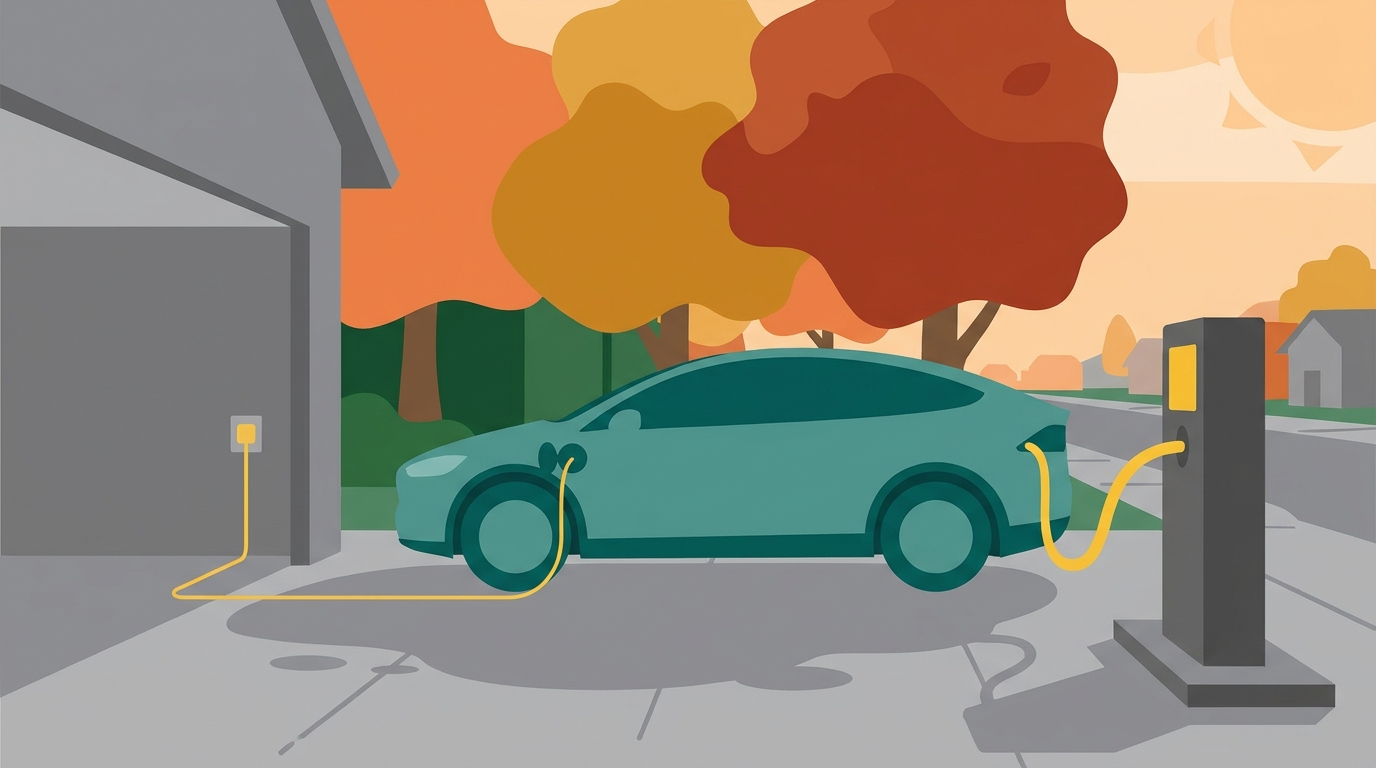
A 2025 Nissan Ariya charges from empty to full in roughly 10.5 hours (63 kWh battery) or 14 hours (87 kWh battery) on a Level 2 home charger, according to Nissan's own estimates. On a 130 kW DC fast charger, the same vehicle can go from 10% to 80% in about 35 to 40 minutes. The practical answer for Everett, WA drivers: plug in overnight at home for daily use, and lean on DC fast charging for road trips.
How long does Level 2 home charging take for a Nissan Ariya in Everett, WA?
Level 2 home charging on a 240V circuit takes approximately 10.5 hours for a full 0–100% charge on 63 kWh Ariya versions and about 14 hours on 87 kWh versions, per Nissan. That timing reflects the Ariya's 7.2 kW onboard AC charger, which is the hard ceiling on how fast the car can accept AC power regardless of what the wall unit is rated for.
The 7.2 kW onboard AC charger is a fixed limit on U.S. Ariyas. Installing a higher-capacity home EVSE — a 9.6 kW or 11.5 kW wall unit, for example — will not shorten charging time, because the vehicle itself tops out at 7.2 kW on AC. For most Snohomish County commuters driving between neighborhoods like Silver Lake, Mukilteo, and downtown Everett, that overnight charging window easily covers a daily commute of 30 to 60 miles.
Level 1 charging on a standard 120V household outlet is a different story: it adds only a few miles of range per hour and is impractical as a primary charging method for a battery the size of the Ariya's. Any driver committing to an EV should plan on a 240V circuit at home — or reliable workplace or public Level 2 access — rather than relying on a wall socket.
How fast is DC fast charging on a Nissan Ariya?
The 2025 Nissan Ariya supports DC fast charging at up to 130 kW, which translates to roughly 35 minutes (63 kWh) or 40 minutes (87 kWh) to go from 10% to 80% state of charge at a station that can actually deliver that peak. On a slower 50 kW DC fast charger, Nissan estimates approximately 65–90 minutes depending on battery configuration.
Two caveats matter here. First, 130 kW is a maximum, not a constant rate — charging slows as the battery fills, which is why Nissan quotes times to 80% rather than 100%. Second, actual speed depends on the station's output, ambient and battery temperature, and the pack's state of health. A cold battery pulled off I-5 in a January rainstorm will accept power more slowly than a pre-conditioned pack on a mild day.
What connector does the Nissan Ariya use in the U.S.?
The U.S.-market 2025 Nissan Ariya uses a J1772 connector for Level 1 and Level 2 AC charging and a CCS (Combined Charging System) connector for DC fast charging. It does not use CHAdeMO despite the older Nissan LEAF association with that standard, so CHAdeMO-only stations are not an option.
A Nissan-approved NACS adapter opens up compatible Tesla Supercharger stations as another DC fast-charging option. The adapter is listed at $235. Drivers should confirm specific Supercharger site compatibility before relying on it, since not every Supercharger location is open to non-Tesla vehicles.
Which charging method should Everett, WA Ariya drivers rely on day to day?
For routine use, Level 2 home charging is the correct default; DC fast charging is best reserved for road trips, longer regional drives, or days when home charging isn't available. The reasoning: Level 2 at home uses residential electricity rates, is gentler on the battery over the long term, and requires no planning around station availability. DC fast charging is faster but costs more per kWh at public stations and generates more heat in the pack.
Pacific Northwest weather is relevant here. Cold, wet winter mornings reduce both range and charging speed, which makes a reliable overnight home charge more valuable in Everett than in a milder climate. A battery that starts the day topped off at home avoids the compounding problem of trying to recover range at a public DC station in 38-degree rain.
A reasonable rule of thumb: Level 2 is the routine; DC fast charging is the exception. Most Ariya owners end up using both — the home charger five or six nights a week, and a public CCS station for the occasional trip south to Seattle, east over Stevens Pass, or north toward Bellingham.
What does the Nissan Ariya cost, and how does Nissan of Everett fit in?
According to Nissan, the 2025 Ariya has a starting MSRP of $39,770 for the Engage FWD trim, before destination and handling. The Ariya lineup includes six trims — Engage FWD, Engage e-4ORCE, Evolve+ FWD, Engage+ e-4ORCE, Evolve+ e-4ORCE, and Platinum+ e-4ORCE — with horsepower ranging from 214 hp on the Engage FWD to 389 hp on the top e-4ORCE configurations. EPA efficiency ranges from 90 MPGe (Platinum+ e-4ORCE) to 101 MPGe (Engage FWD).
For Everett, WA buyers evaluating the Ariya against other Nissan EVs, the 2026 Nissan LEAF, starting at $29,990 (as of October 2026) is the entry point into Nissan's electric lineup, and the 2026 Nissan Rogue Plug-in Hybrid, starting at $45,990 (as of October 2026) is an alternative for drivers who want electric daily driving without full reliance on public DC infrastructure. Nissan of Everett sells new Nissan vehicles, Certified Pre-Owned Nissan vehicles, and used cars, trucks, and SUVs, and its sales team can walk through battery options, connector details, and what a Level 2 install typically involves before any paperwork is signed.
Nissan Ariya charging at a glance
| Dimension | Level 2 home (240V) | DC fast charging (CCS) |
|---|---|---|
| Peak power | 7.2 kW (onboard AC limit) | Up to 130 kW |
| Time to full / 80% | ~10.5 hrs (63 kWh) / ~14 hrs (87 kWh), 0–100% | ~35 min (63 kWh) / ~40 min (87 kWh), 10–80% |
| Connector | J1772 | CCS (NACS adapter at $235 for Tesla Superchargers) |
| Best for | Overnight routine charging | Road trips and quick top-ups |
| Cost basis | Home utility rate + one-time EVSE install | Set by station operator; varies |
What does a recent Nissan of Everett buyer say?
Juan at Nissan of Everett was exceptional to work with when we came in to purchase our first car today! He made the process so easy and seamless. The finance department was also incredible to work with. Jerry and I will buy our next car from him when we are ready. Thanks again to Juan! Sincerely, Carla from Lacey, WA
Frequently asked questions
How many hours does a full home charge take on a Nissan Ariya?
On a 240V Level 2 charger, a full 0–100% charge takes approximately 10.5 hours for Ariya versions with the 63 kWh battery and about 14 hours for versions with the 87 kWh battery, according to Nissan. The U.S. Ariya's onboard AC charger is rated at 7.2 kW, which caps how fast the car can take AC power regardless of the wall unit's rating.
How long does DC fast charging take on an Ariya?
At a 130 kW DC fast charger — the Ariya's maximum — Nissan estimates roughly 35 minutes for 63 kWh versions and 40 minutes for 87 kWh versions to charge from 10% to 80%. On a slower 50 kW station, those times stretch to approximately 65–90 minutes depending on battery configuration. Actual charging speed varies with station output, battery temperature, and state of charge.
Does the 2025 Nissan Ariya use CHAdeMO like the LEAF?
No. The 2025 Nissan Ariya in the U.S. market uses a CCS (Combined Charging System) connector for DC fast charging, not CHAdeMO. CHAdeMO-only stations are not compatible with the Ariya. A Nissan-approved NACS adapter, listed at $235, also allows access to compatible Tesla Supercharger stations.
Will a higher-amperage home charger speed up Ariya charging?
No. The 2025 Nissan Ariya's onboard AC charger is rated at 7.2 kW, which is the ceiling for Level 2 charging. Installing a 9.6 kW or higher wall unit will not reduce charging time, because the limit sits in the vehicle, not the EVSE. A 7.2 kW–capable Level 2 unit on a properly sized 240V circuit is sufficient for the Ariya.
Is it worth DC fast charging for daily driving?
For most Ariya owners, no. Level 2 home charging covers daily commuting needs overnight, uses residential electricity rates, and is gentler on the battery over the long term. DC fast charging is better suited to road trips, longer regional drives, or situations where home charging isn't available. Many owners use both methods for different purposes.
Does the Nissan Ariya warranty cover the EV battery?
Yes. The Nissan Ariya's EV battery is covered by an 8-year/100,000-mile warranty. Basic coverage is 3 years/36,000 miles and powertrain coverage is 5 years/60,000 miles. Those terms apply regardless of whether an owner primarily uses Level 2 home charging or public DC fast charging.
The bottom line for Everett, WA Ariya shoppers
Level 2 at home is the right default for a Nissan Ariya: overnight charging on a 240V circuit covers virtually any daily driving pattern in Snohomish County, and the car's 7.2 kW onboard AC limit makes a modest Level 2 unit all the hardware a driver needs. DC fast charging over CCS, at up to 130 kW, is the right tool for road trips and the occasional quick top-up — not for the daily routine.
Readers in Everett, WA who want to see the Ariya in person, confirm trim pricing, or talk through what a home Level 2 install looks like for their situation can reach Nissan of Everett at (425) 347-5763 or https://www.nissanofeverett.com to get started.