Fair Car Deal Checklist for Kirkland, WA Buyers
A Washington State buyer's checklist for verifying dealer pricing, taxes, fees, and financing terms — with specific guidance for Kirkland shoppers.
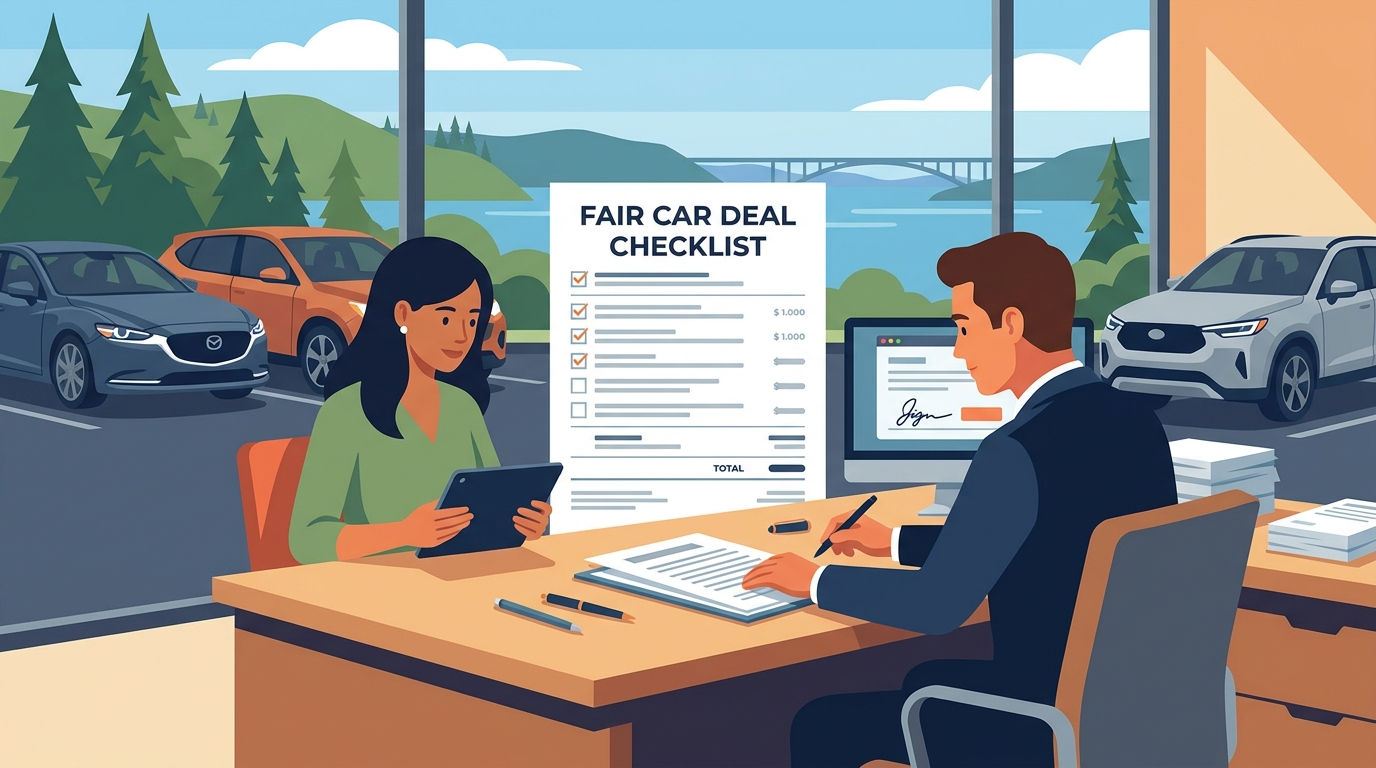
A fair deal at a Washington State dealership is one where the out-the-door price matches the sum of a competitive vehicle price, Washington's 6.5% state sales tax plus local Kirkland sales tax (roughly 10.2-10.3% combined), documented government fees, and a documentary service fee capped by state law at $200 — with any dealer add-ons itemized and optional. If the numbers on the buyer's order reconcile against those benchmarks and the financing terms match what was quoted verbally, the deal is fair.
Vehicle pricing in Washington shifted noticeably in 2026, with tighter new-vehicle inventory in the Puget Sound region and more variable used-car pricing tied to King County demand. That volatility makes it harder for buyers in Kirkland, Juanita, Totem Lake, and Rose Hill to know whether the number on the buyer's order reflects the market — or reflects what the dealer thought the buyer would accept. The checklist below is how to tell the difference.
What defines a fair car deal in Washington State?
A fair deal in Washington means the vehicle price sits within the current regional market range, sales tax is calculated correctly on the post-trade-in difference (Washington does credit trade-in value against taxable price), the documentary service fee does not exceed the $200 statutory cap, and every line item on the buyer's order is disclosed before signing. No mandatory add-ons, no unexplained markups.
Kirkland buyers should treat the buyer's order as the source of truth. Verbal promises made in the sales office carry no legal weight once the paperwork is signed. Reputable Washington dealerships like Nissan of Everett, roughly a 20-minute drive north on I-405, structure their buyer's orders so every fee, tax, and add-on is itemized and explained before a signature is requested.
How can Kirkland buyers verify the vehicle price is competitive?
Pull three data points before negotiating: the manufacturer's MSRP from the window sticker, the Kelley Blue Book or Edmunds fair market range for the exact trim and mileage, and at least two competing quotes from Washington dealers within a 40-mile radius. If the dealer's price sits within or below the KBB fair market range and matches or beats competing quotes, it's competitive.
The Monroney sticker (federally required on new vehicles) lists MSRP, standard equipment, and factory-installed options. Any dealer-added items — appearance packages, VIN etching, nitrogen tires, theft protection — appear on a separate addendum sticker and are almost always negotiable or removable. Washington law does not require buyers to accept dealer add-ons to complete a purchase.
What fees are legitimate at a Washington dealership in 2026?
Legitimate fees in Washington include the documentary service fee (capped at $200 by RCW 46.12.042), state and local sales tax, vehicle license fee, title fee, license plate fee, and the state's regional transit authority (RTA) motor vehicle excise tax if the buyer's address falls inside the Sound Transit district — which includes most of Kirkland. Everything else deserves scrutiny.
Common fees to question
- Dealer prep or dealer handling fees beyond the $200 doc fee — often duplicative
- Market adjustment or "additional dealer markup" — legal but negotiable, especially in 2026's softening market
- Theft recovery, VIN etching, paint sealant — nearly always optional
- GAP insurance and extended warranties — legitimate products, but priced with significant markup; can be purchased later or elsewhere
How does the Kirkland sales tax calculation work?
Kirkland's combined sales tax rate in 2026 is approximately 10.2-10.3%, combining Washington's 6.5% state rate with King County and city-level local taxes. Sales tax applies to the vehicle price minus any trade-in credit — Washington is one of the states that allows trade-in value to reduce the taxable amount, which can save several hundred to several thousand dollars on the total.
Buyers inside the Sound Transit boundary — which covers Kirkland, Bellevue, Redmond, and most of the Eastside — also pay the RTA motor vehicle excise tax, calculated on a depreciation schedule tied to the vehicle's base MSRP. This is a separate line item from sales tax and is legitimate; it is not a dealer fee.
What should the out-the-door price breakdown look like?
An honest out-the-door price is the sum of five categories, itemized clearly. If a dealer resists showing the breakdown or bundles fees into a single "processing" line, that is a signal to slow down and request itemization before proceeding.
| Line Item | Typical Range (Washington 2026) | Fair? |
|---|---|---|
| Vehicle sale price | Within KBB fair market range | Yes if verified |
| Documentary service fee | Up to $200 (state cap) | Yes at or below cap |
| Sales tax (Kirkland) | ~10.2-10.3% of taxable price | Yes |
| Title, plates, license | ~$75-$200 combined | Yes |
| RTA excise tax (if applicable) | Varies by MSRP and age | Yes inside Sound Transit district |
| Dealer add-ons | Highly variable | Only if buyer opted in |
| Market adjustment / ADM | $0 in a fair deal | Negotiable — often removable |
How can buyers tell if the financing terms are fair?
Fair financing terms mean the APR quoted matches the buyer's credit tier at prevailing 2026 Washington rates, the loan term is disclosed in months, and the total finance charge is shown in dollars — not just as a monthly payment. Dealers earn a finance reserve on marked-up rates, so buyers should compare the dealer's offer to a pre-approval from their own credit union or bank before signing.
Puget Sound-area credit unions frequently quote auto rates 0.5-1.5 percentage points below dealer-arranged financing in 2026. Bringing a pre-approval to the dealership gives buyers a benchmark and, often, negotiating leverage — the dealer may match or beat it to keep the finance contract.
What are the warning signs of an unfair deal?
Warning signs include a refusal to provide a written buyer's order before financing discussions, sudden fee additions between the negotiated price and the F&I office, mandatory add-ons framed as "already installed," pressure to focus on monthly payment instead of total price, and any resistance to the buyer taking the buyer's order home for review.
Nissan of Everett's 4.4-star rating across more than 1,000 Google reviews reflects the practical value of the opposite approach — one recent reviewer described the experience as "the best car shopping and buying experience I could ask for," and another noted an "extremely reasonable price" without pressure. Consistent themes in reviews of reputable Washington dealers are transparency on the buyer's order, willingness to itemize every fee, and no last-minute additions.
Frequently Asked Questions
Is the $200 documentary fee negotiable in Washington?
The $200 documentary service fee is a state-imposed cap under RCW 46.12.042, not a required charge — dealers may charge up to $200 but can charge less or waive it. In practice, most Washington dealerships charge the full $200, and it is rarely negotiated down. It is legitimate as long as it does not exceed the cap and is disclosed on the buyer's order.
Does Washington give a sales tax credit for trade-ins?
Yes. Washington calculates sales tax on the difference between the new vehicle's price and the trade-in credit, not on the full new vehicle price. For a Kirkland buyer trading in a $15,000 vehicle against a $35,000 purchase, sales tax applies to the $20,000 difference — saving roughly $1,500 in tax at the local combined rate compared to states without trade-in credit.
What is the RTA excise tax and do Kirkland buyers pay it?
The RTA motor vehicle excise tax funds Sound Transit and applies to vehicles registered inside the Regional Transit Authority district, which includes most of Kirkland, Bellevue, Redmond, Seattle, and surrounding Puget Sound cities. The tax is calculated using a depreciation schedule against the vehicle's base MSRP and appears as a separate line during registration — it is not a dealer fee and is not negotiable.
Can a Washington dealer add fees after the buyer's order is signed?
No. Once a buyer's order is signed by both parties, the terms are contractually fixed. Any fees not listed on the signed buyer's order cannot be added later. Buyers who see new charges appear during the F&I meeting should stop and request the original buyer's order — legitimate dealers will honor the signed document.
How much room is there to negotiate the vehicle price in 2026?
Negotiation room in 2026 varies by inventory pressure — high-demand trims and popular hybrids often sell at or near MSRP with little movement, while slower-moving models and end-of-model-year units may negotiate 3-8% below MSRP. Used vehicles typically show more flexibility. Comparing quotes from at least two Washington dealers is the most reliable way to identify the actual negotiation range.
Should Kirkland buyers get financing pre-approved before visiting a dealer?
Yes. A pre-approval from a Puget Sound credit union or bank gives buyers a benchmark APR to compare against dealer-arranged financing, which typically includes a markup called dealer reserve. Buyers who bring a pre-approval frequently see the dealer match or beat the outside rate, and even when they don't, the pre-approval confirms whether the dealer's financing offer is fair for the buyer's credit profile.
Closing thought for Kirkland shoppers
Verifying a fair deal in Washington comes down to reconciling the buyer's order against known benchmarks: KBB market range, the $200 doc fee cap, the ~10.2-10.3% Kirkland sales tax rate applied to the post-trade-in amount, and financing terms that match an independent pre-approval. Buyers who work through that checklist rarely leave money on the table. Readers in Kirkland who want the process handled with itemized paperwork and no surprises can reach Nissan of Everett at https://www.nissanofeverett.com to start the conversation.