Car Trade-In at a Nissan Dealership in Bellevue, WA
How Washington's trade-in sales tax offset works at Bellevue Nissan dealers, what documents to bring, and how the 2026 luxury vehicle tax changes the math.

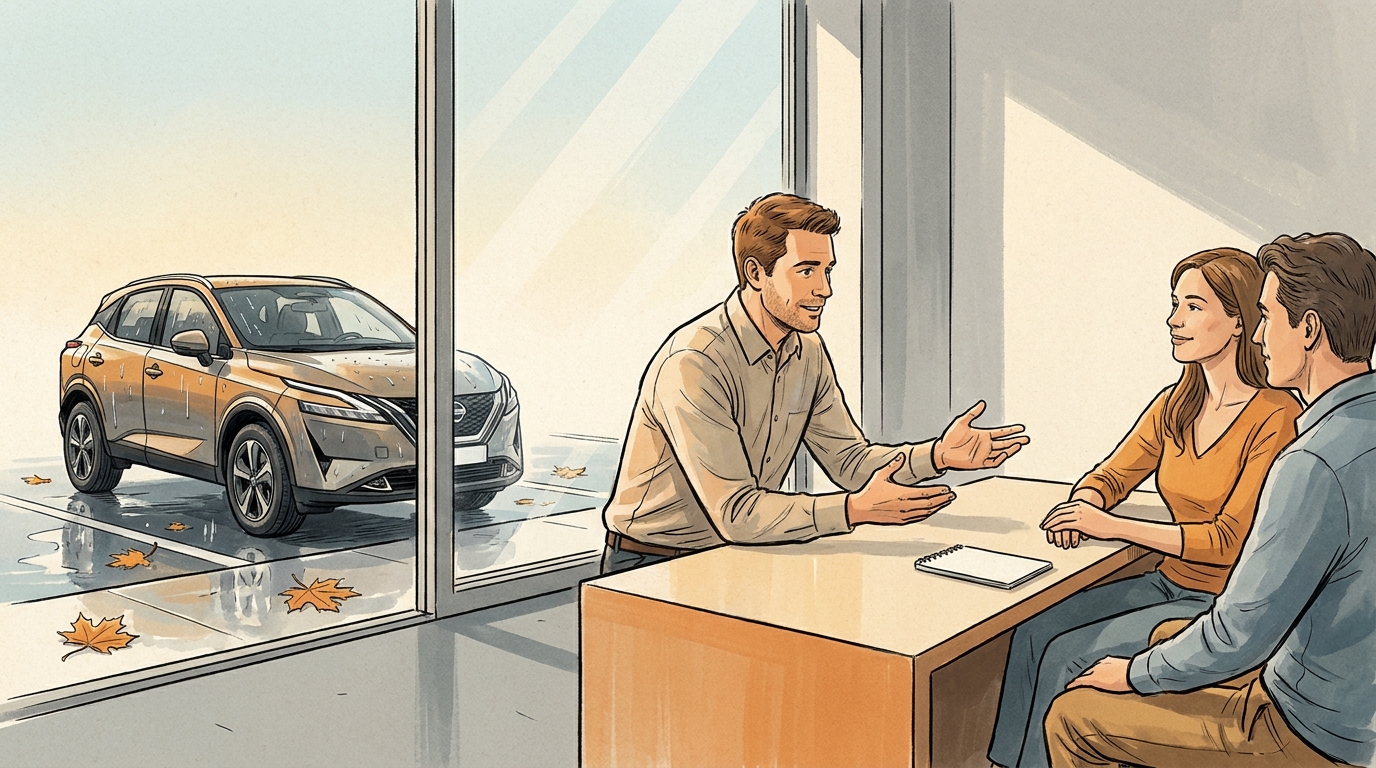
Trading in a vehicle at a Nissan dealership in Bellevue, WA works essentially the same way it does anywhere in Washington: the dealer appraises the trade, applies the allowance against the price of the vehicle being purchased, and — critically — the state lets the trade-in value reduce the taxable selling price for retail sales tax purposes. That single rule, codified in RCW 82.08.010 and WAC 458-20-247, is often worth more to a Bellevue buyer than any dealer negotiation on the trade itself.
This guide walks through how the trade-in process runs at a Bellevue Nissan store, what Washington's tax offset actually saves, what documents to have ready, and how the new 8% luxury motor vehicle tax that took effect January 1, 2026 changes the calculation for higher-priced vehicles.
How Washington's Trade-In Sales Tax Credit Works in 2026
Under RCW 82.08.010 and WAC 458-20-247, the taxable selling price for Washington retail sales tax on a vehicle is reduced by the trade-in allowance of a like-kind vehicle accepted by the dealer at the time of sale. In plain terms, sales tax is calculated on the net difference — new vehicle price minus trade allowance — not the gross price. This is a materially better deal than states like California, which tax the full purchase price regardless of trade.
For a Bellevue buyer, that offset compounds quickly. Combined state and local sales tax rates in Bellevue sit above 10% (the exact rate is set by the Department of Revenue and should be verified with DOR for a given transaction). On a $15,000 trade against a new Nissan Rogue or Pathfinder, the tax savings alone routinely exceed $1,500 — money the customer would otherwise pay to the state, not the dealer.
What Qualifies as a Like-Kind Trade
The offset only applies when the trade is a like-kind motor vehicle: vehicle-for-vehicle. WAC 458-20-247 is specific about what "like-kind" means across categories — only boats trade for boats, only snowmobiles for snowmobiles, and recreational land vehicles must be traded for travel trailers, campers, tent-camping trailers, or motor homes. A car for a car is straightforward; a boat traded toward a new Nissan is not, and no offset applies.
Leased Vehicles Do Not Qualify
If the vehicle being traded in is currently leased, the sales tax offset is not available. WAC 458-20-247 and RCW 82.08.010 require the customer to own the trade-in — a lessee does not hold ownership, so the leased vehicle cannot serve as a qualifying trade. Bellevue drivers coming off a lease can still turn the vehicle in, but they should not expect the state trade-in tax credit to reduce the tax on their next purchase.
The Nissan Trade-In Process, Step by Step
The mechanics at a Nissan dealership follow a consistent sequence. Understanding each step helps Bellevue buyers arrive prepared and avoid the two mistakes that most often cost money: undocumented allowances and cash-back structures that void the tax offset.
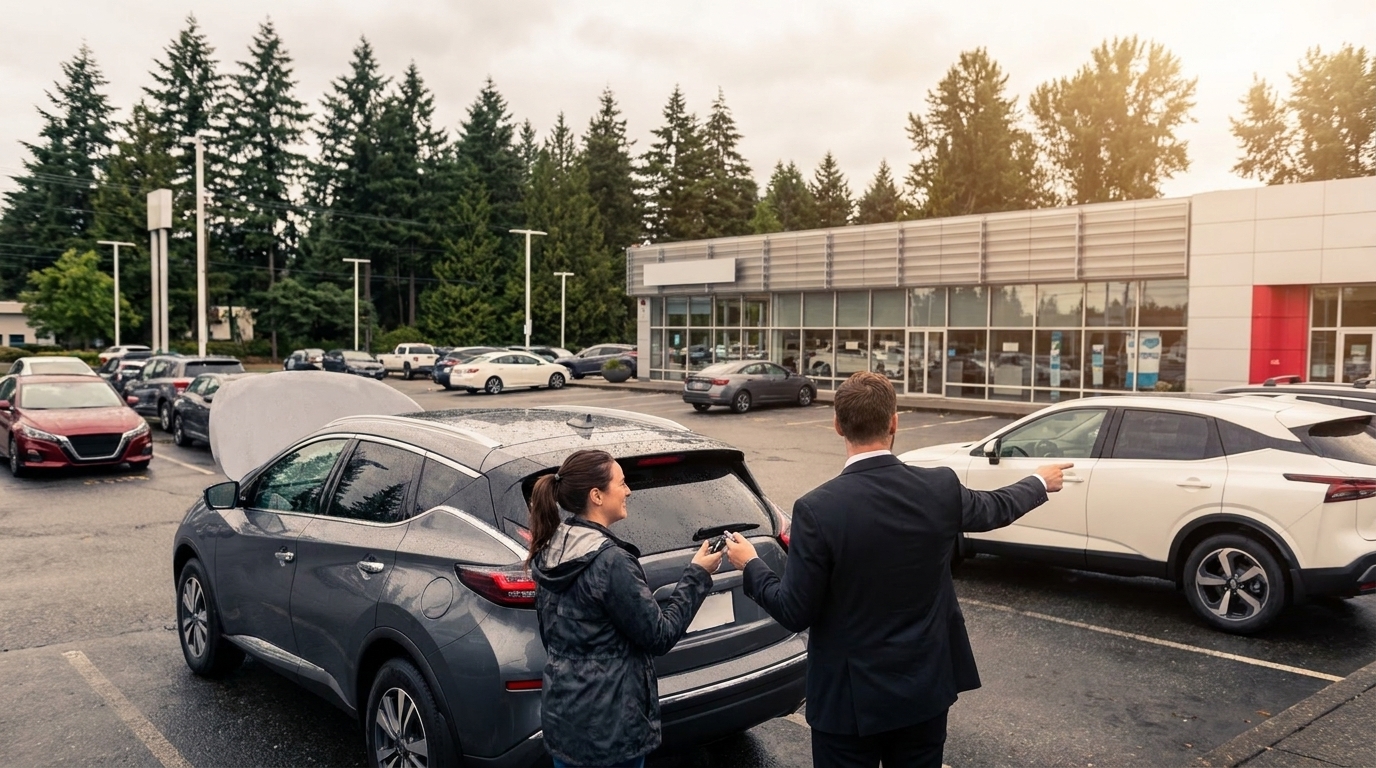
- Appraisal. The dealer inspects the vehicle, pulls the VIN history, checks mileage and condition, and produces a written trade offer. Independent valuations from third-party pricing tools are useful as a sanity check.
- Payoff verification. If there is a loan on the trade, the dealer contacts the lienholder for a 10-day payoff quote. Positive equity is applied toward the new purchase; negative equity can be rolled in but does not reduce sales tax.
- Purchase agreement. The trade type and allowance must be clearly identified on the sales agreement or invoice — this documentation is what WAC 458-20-247 requires to establish the offset.
- Tax calculation. Sales tax is computed on the selling price minus the trade allowance, then combined state and local rates are applied to that net figure.
- Title and ownership transfer. The dealer takes ownership of the trade at the time of sale — a condition of the offset under state rules.
Why Cash-Back Structures Can Cost You
If a dealer gives cash back to the customer rather than applying the full trade-in allowance to reduce the selling price, the offset is limited to the portion actually applied against the price. A $15,000 trade split as $10,000 against the new vehicle and $5,000 cash to the customer only offsets $10,000 of taxable selling price. This is a common misstep in deals where buyers want walk-away cash; it is worth calculating the tax cost before agreeing to that structure.
The 2026 Luxury Motor Vehicle Tax: Why the Trade-In Rule Flips
Effective January 1, 2026, Washington imposes an additional 8% luxury motor vehicle tax on non-commercial vehicles whose selling price exceeds a statutory deduction threshold. The threshold is $100,000 from January 1 through June 30, 2026, and increases 2% each July 1 thereafter — rising to $102,000 on July 1, 2026 and adjusting annually. For most Nissan buyers in Bellevue, this will never come into play; the tax is aimed at high-end vehicles and rarely touches mainstream inventory.
Where it matters, though, the math is unfriendly. For the luxury tax, trade-in values do not reduce the taxable base. In fact, per DOR guidance implementing RCW 82.08.020(3), the taxable amount is calculated as the selling price plus the trade-in property value, minus the current statutory deduction — the trade is added back in rather than subtracted. Buyers considering a vehicle near the threshold should model both the ordinary sales tax (where the trade helps) and the luxury tax (where it does not).
Vehicles Exempt From the Luxury Tax
Several categories are excluded regardless of price. Commercial motor vehicles as defined in RCW 46.25.010, vehicles with a gross weight rating exceeding 10,000 pounds (other than motor homes), farm tractors and farm vehicles, off-road vehicles, and snowmobiles are all exempt from the 8% luxury tax under the enabling statute.
The EV Tax Exemption Sunset
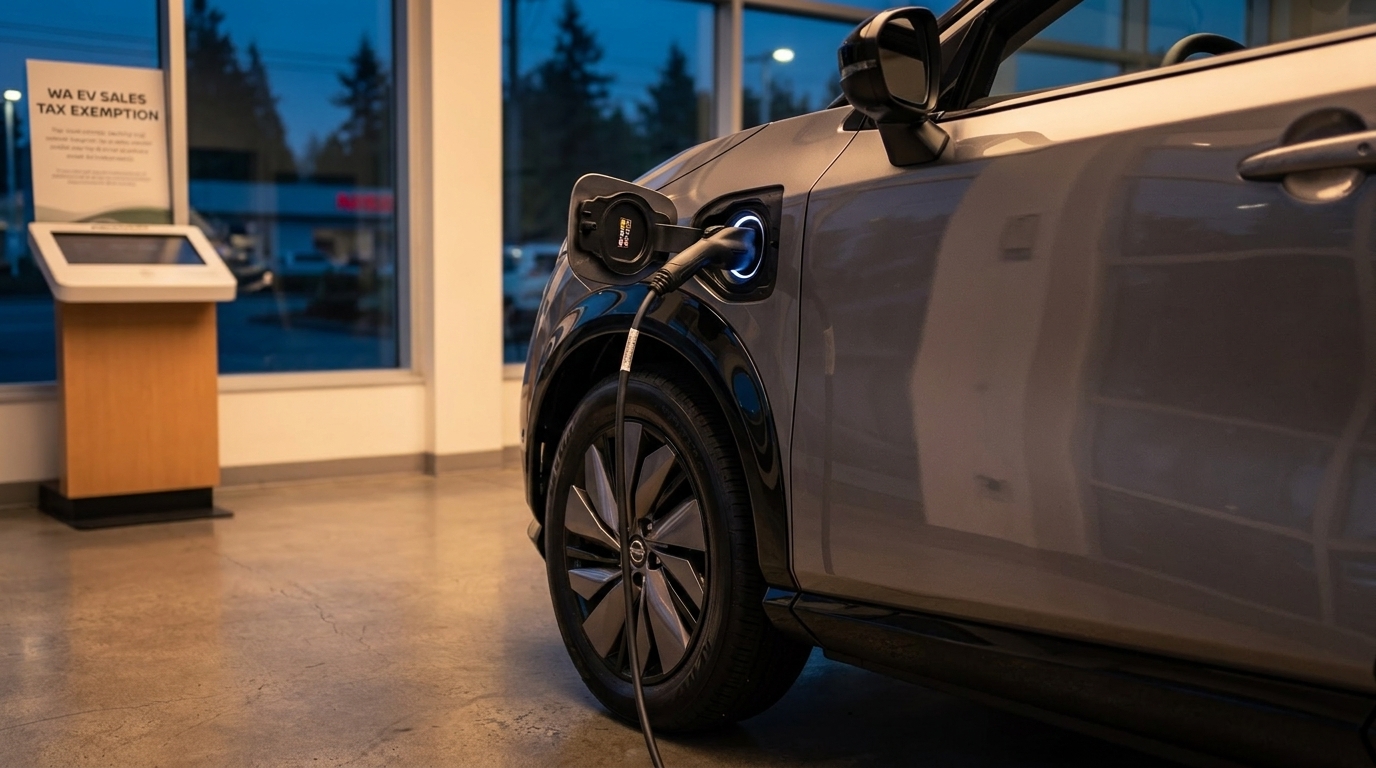
Qualifying lease payments remain exempt until August 1, 2028, but for new EV purchases in Bellevue in 2026, there is no general state sales tax exemption. A Nissan LEAF or ARIYA purchased today is taxed at the standard combined Bellevue rate, with the ordinary trade-in offset available on the taxable base. Federal clean vehicle credits are governed separately and warrant a conversation with a tax professional.
What Bellevue Buyers Should Bring to the Appointment
- Title (if owned outright) or lienholder contact information and account number
- Current registration and Washington driver's license
- All keys and remotes — missing keys are a common line-item deduction
- Service records, if available, particularly for maintenance-sensitive Nissan models
- Any aftermarket parts or receipts that support the appraisal
Cross-lake traffic on I-90 and SR-520 makes timing worth thinking about. Buyers coming from Seattle or the Eastside neighborhoods around Downtown Bellevue, Crossroads, or Factoria often find that mid-morning or early-afternoon appointments move faster than evenings and weekends, when appraisal desks stack up.
FAQ
Does Washington charge sales tax on the full price or just the difference after trade-in?
Washington charges retail sales tax only on the difference after a qualifying like-kind trade-in, per RCW 82.08.010 and WAC 458-20-247. The trade allowance must be documented on the sales agreement and the dealer must take ownership at the time of sale.
Can I trade in a leased Nissan and still get the tax credit?
No. Leased vehicles do not qualify as like-kind trade-ins under Washington law because the lessee does not hold ownership. The vehicle can still be returned, but no sales tax offset is available on the next purchase.
How does the 2026 luxury motor vehicle tax affect my trade-in?
The 8% luxury tax applies only to vehicles above the statutory deduction threshold ($100,000 through June 30, 2026; $102,000 starting July 1, 2026). Unlike ordinary sales tax, the trade-in value does not reduce the base — it is added back in before the deduction is applied.
Are there still EV sales tax exemptions in Washington in 2026?
Qualifying lease payments remain exempt through August 1, 2028.
The Bottom Line for Bellevue Trade-Ins
Washington's trade-in tax offset is one of the more buyer-friendly rules in the country, and it is the single biggest reason to trade a vehicle in rather than sell it privately in Bellevue. The savings on sales tax often close the gap — or more — between a private-party sale price and a dealer trade offer, without the logistics of listing, showing, and transferring a title yourself.
Buyers in Bellevue who want the trade-in structured correctly under Washington law, with the allowance properly documented and the tax offset applied against the selling price, can reach Nissan of Everett at https://www.nissanofeverett.com to schedule an appraisal and review current inventory. For questions about how the 2026 luxury tax or the expired EV exemption apply to a specific transaction, the Washington Department of Revenue and a qualified tax professional remain the authoritative resources.