Car Financing Options in Bellevue, WA: What to Expect
How dealer financing actually works for Bellevue buyers — Washington disclosure rules, lender types, APR expectations, and what to review before signing.

Bellevue car buyers generally have four practical financing paths: dealer-arranged financing through a bank or captive lender, direct financing from a credit union or bank, manufacturer promotional financing on new inventory, and cash. Dealer-arranged financing is the most common because dealers submit a single credit application to multiple lenders at once, and Washington law requires the resulting retail installment contract to disclose the full finance charge and APR in writing.
Financing a vehicle in Bellevue involves more than picking a monthly payment. The Eastside market — from Downtown Bellevue and Crossroads out to Factoria and Bel-Red — skews toward buyers with strong credit profiles and dual-income households, which shapes what lenders offer and which promotional programs actually apply. Understanding the mechanics before walking into a dealership is what separates a clean transaction from one that costs thousands more over the loan term.
What car financing options do Bellevue buyers actually have?
Bellevue buyers typically choose among four options: dealer-arranged indirect financing (the dealer shops your application to partner lenders), direct financing secured in advance from a bank or credit union, manufacturer captive financing (for example, Nissan Motor Acceptance Corporation on new Nissan inventory), and cash purchase. Each carries different APR structures, approval speeds, and negotiating leverage at signing.
Dealer-arranged financing dominates because of convenience: one application, multiple lender responses, and same-day funding. Dealerships like Nissan of Everett, which serves buyers across Snohomish and King counties including Bellevue, submit applications to a panel of banks and credit unions to find the strongest available terms for a given credit profile. Direct financing — walking in pre-approved from a Puget Sound credit union — can be a useful benchmark, but pre-approvals expire after a limited period and may not match promotional captive rates on new vehicles.
Manufacturer promotional financing
Captive lenders periodically offer subvented APRs (often described as 0% to 3.9% on qualifying new models) that no outside bank can match, because the manufacturer subsidizes the rate. These programs typically require top-tier credit and specific model-year and trim combinations. They are also usually mutually exclusive with cash rebates, so the real comparison is total cost over the loan term, not headline rate.
How does dealer financing actually work in Washington State?
In Washington, dealer financing is governed primarily by chapter 63.14 RCW (the Retail Installment Sales Act) and WAC 308-66, enforced by the Department of Licensing. The dealer collects a credit application, submits it to lender partners, receives approval terms (rate, term, advance amount), and presents a written retail installment contract that must itemize cash price, down payment, finance charge, total of payments, payment schedule, and collateral description.
The contract must also include a statutory disclosure about cancellation rights under RCW 63.14.154 — typically the language stating the buyer does NOT have the right to cancel, because standard vehicle purchases are not covered by that statute. Washington has no general "cooling-off period" for signed auto contracts, which is why reviewing terms carefully at signing matters more here than buyers sometimes assume.
Advertising is also regulated. Under WAC 308-66, any dealer advertisement that mentions a specific credit term — down payment amount, monthly payment, number of payments, or a financing rate — must also clearly disclose the cash price, down payment, payment schedule, and APR. A rate that has been "bought down" by the dealer is unlawful to advertise unless the actual APR appears alongside it.
What disclosures should appear on the contract?
A compliant Washington motor vehicle retail installment contract must include vehicle identification, cash price, down payment, finance charge (time price differential), total of payments, payment schedule, description of collateral, and the RCW 63.14.154 cancellation-rights disclosure. Federal Truth in Lending Act disclosures — APR, finance charge, amount financed, and total of payments — appear in the standard "Fed Box" on the same document.
One item Washington does NOT require: separate disclosure of dealer reserve (the markup a dealer may add to the lender's buy rate). The state does not cap that markup or require it to be itemized to the buyer. Only the total finance charge and APR must be disclosed. Buyers who want the sharpest rate should ask directly what the lender's buy rate is or compare the offered APR against an independent pre-approval.
What APRs and terms should Bellevue buyers expect in 2026?
Actual APRs vary by credit tier, loan term, vehicle age, and lender, but the pattern in the Puget Sound market is consistent: new-vehicle APRs for prime and super-prime credit typically fall well below used-vehicle APRs, and captive promotional rates on new inventory are usually the lowest available. Loan terms of 60 and 72 months are the most common; 84-month terms exist but materially increase total interest paid and negative-equity risk.
| Financing Path | Typical Use Case | Key Advantage | Key Tradeoff |
|---|---|---|---|
| Captive (manufacturer) financing | New Nissan or other new-vehicle purchase | Subvented promotional APRs on qualifying models | Often can't be combined with cash rebates |
| Dealer-arranged bank/credit union | New or used, most credit profiles | One application, multiple lender offers | Rate may include dealer markup over buy rate |
| Direct credit union pre-approval | Buyers with established banking relationships | Known rate before negotiation | May not match captive promotional programs |
| Cash | Buyers avoiding interest entirely | No finance charge, simpler closing | Forgoes any rebate tied to financing |
Are there Washington rules protecting buyers from predatory auto lending?
Yes. Non-bank consumer lenders operating in Washington — including any company making vehicle-title-secured loans — must be licensed under chapter 31.04 RCW (the Consumer Loan Act) and are capped at 25% per annum simple interest under RCW 31.04.105(1) and WAC 208-620-235. Origination fees are limited to 4% of the first $20,000 of principal and 2% above that. This effectively prohibits the triple-digit APR title loans common in less-regulated states.
The Department of Financial Institutions (DFI), Division of Consumer Services, enforces those rules through licensing actions, cease-and-desist orders, and restitution. Dealer advertising and financing practices, separately, are enforced by the Department of Licensing under WAC 308-66 and RCW 46.70.180, with authority to suspend dealer licenses and impose civil penalties. Buyers can also pursue private claims under the Retail Installment Sales Act and the Consumer Protection Act (RCW 19.86).
What should Bellevue buyers do before signing?
Bellevue buyers should get a pre-approval from a bank or credit union first, verify their credit score, calculate the maximum total loan cost they'll accept (not just the monthly payment), and read the full retail installment contract line by line before signing. The RCW 63.14.154 disclosure means there's generally no cancellation window once the contract is signed — the review needs to happen at the desk, not the driveway.
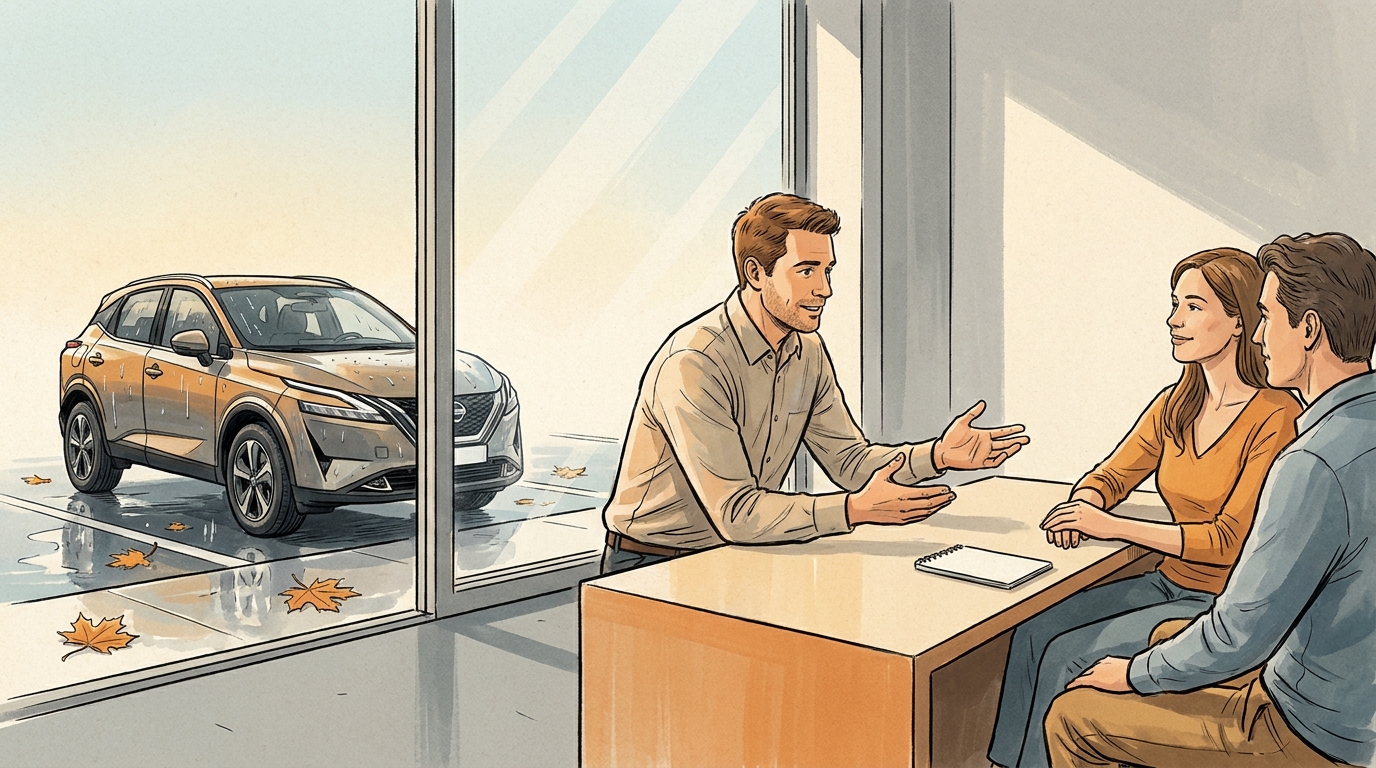
Buyers should confirm the cash price matches what was negotiated, that any trade-in allowance and down payment are recorded correctly, that add-on products (GAP, service contracts, appearance packages) are optional and priced clearly, and that the APR on the contract matches the offer discussed. Buyers should confirm that the paperwork stage matches the conversation on the showroom floor.
Frequently Asked Questions
Does Washington have a cooling-off period for car purchases?
No. Washington's Retail Installment Sales Act (RCW 63.14) requires the contract to state whether a right to cancel under RCW 63.14.154 applies, and for standard vehicle purchases it does not. Once the retail installment contract is signed, the buyer is generally bound by its terms. This is why reviewing every line — cash price, APR, add-ons, trade-in credit — before signing is essential in Bellevue and the rest of the state.
Can a Bellevue dealer legally mark up my interest rate?
Yes. Washington does not cap dealer reserve (the markup a dealer adds to the lender's buy rate) and does not require the markup to be separately disclosed to the buyer. Only the final APR and total finance charge must appear on the contract. Buyers who want to test whether their offered rate includes markup should compare it against an independent pre-approval from a bank or credit union before agreeing to dealer-arranged financing.
What's the difference between captive financing and bank financing?
Captive financing comes from a manufacturer's own lending arm (for example, Nissan Motor Acceptance Corporation) and can offer subvented promotional APRs the manufacturer subsidizes on qualifying new models. Bank or credit union financing comes from an independent lender at market rates. Captive rates are often lower on new vehicles but may exclude cash rebates; bank rates are typically more competitive on used vehicles or when rebates are the better trade.
Do I need to be pre-approved before visiting a dealership?
Pre-approval isn't required, but it's useful as a benchmark. A pre-approval from a credit union or bank gives the buyer a known APR to compare against dealer-arranged offers, and it can speed up the transaction. Dealers in Bellevue routinely work with buyers who arrive pre-approved and will still shop lender partners in case they can beat the pre-approved rate — buyers keep whichever offer is stronger.
Are title loans legal in Washington State?
Washington has no separate title-loan statute. Any company making vehicle-title-secured consumer loans must be licensed under chapter 31.04 RCW (the Consumer Loan Act) and is capped at 25% per annum simple interest, with origination fees limited to 4% of the first $20,000 of principal and 2% above that. This effectively prohibits the high-APR title loans common in other states. The Department of Financial Institutions enforces these limits.
What credit score do I need to finance a car in Bellevue?
There is no single minimum score — lenders in the Bellevue market approve across a wide credit range, though APR rises sharply as scores drop. Prime and super-prime buyers (roughly 700 and above) typically qualify for the lowest bank and captive rates, while sub-prime buyers may still be approved through specialty lenders at materially higher APRs. Down payment size and loan-to-value ratio also affect approval terms.
Getting Financing Reviewed by Someone Local
Bellevue buyers who want to understand their options before committing benefit from working with a dealership that handles the full financing process in-house — from soft credit checks through lender selection to the retail installment contract itself. Readers on the Eastside who want this walked through in person can reach Nissan of Everett at https://www.nissanofeverett.com to discuss inventory, current captive programs, and how the numbers pencil out against an independent pre-approval. The right financing decision usually comes from comparing two or three real offers side by side, not from the first monthly payment quoted.