2026 Nissan Frontier vs Tacoma in Kirkland, WA
Compare the 2026 Nissan Frontier and Toyota Tacoma on towing, MPG, payload, and powertrains — with buyer guidance tailored to Kirkland, WA shoppers.
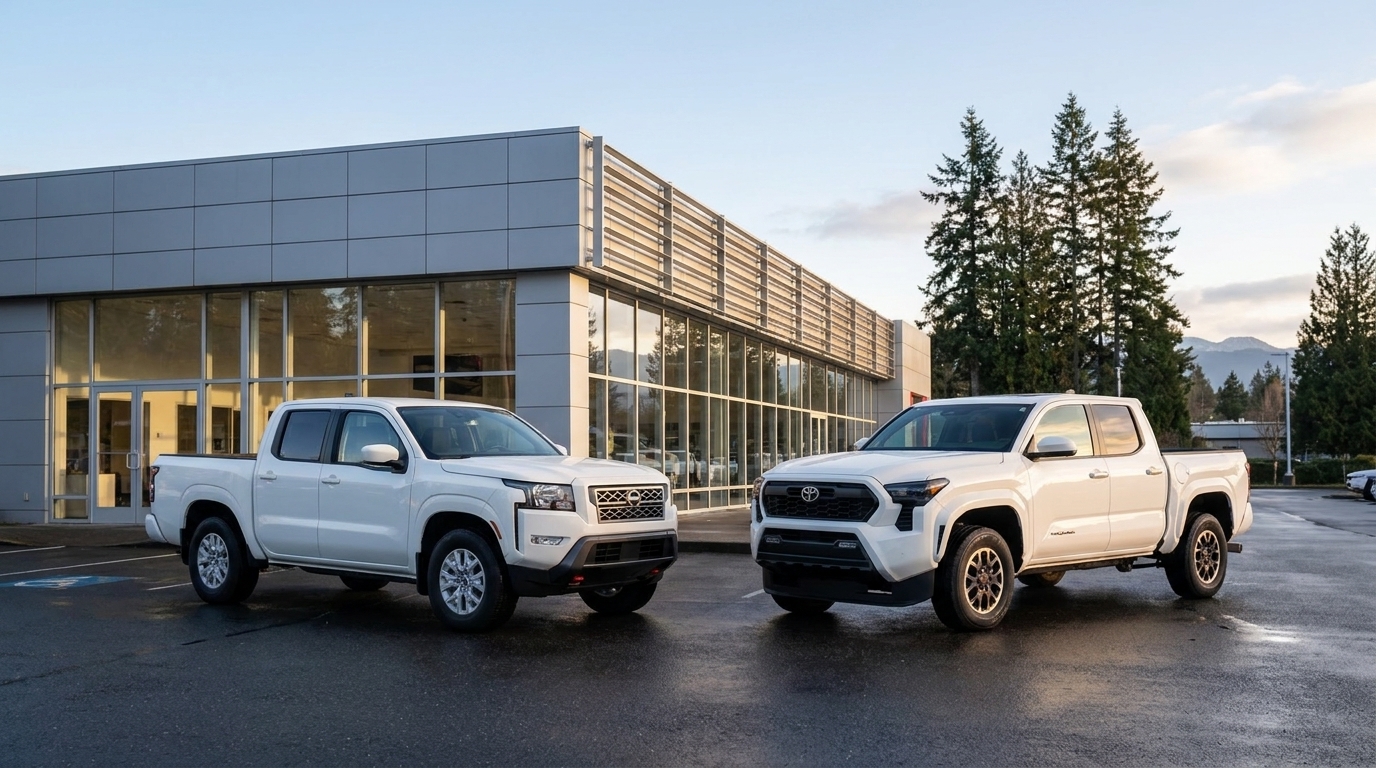
For Kirkland, WA shoppers cross-shopping midsize pickups in 2026, the choice between the Nissan Frontier and Toyota Tacoma comes down to a clear split: the Frontier delivers stronger standard horsepower and higher maximum towing with a simpler lineup, while the Tacoma counters with better fuel economy, more trim variety, and an available hybrid. Both trucks start within roughly $5 of each other at base MSRP, so the decision hinges on how the truck will be used — not on sticker price.
What follows is a dimension-by-dimension comparison built on verified 2026 manufacturer specifications, framed for buyers navigating the Eastside market — from the neighborhoods above Juanita Bay to the commuters running I-405 between Totem Lake and Bellevue.
Starting MSRP: A Near-Tie at the Base
The 2026 Nissan Frontier and 2026 Toyota Tacoma start at nearly identical MSRPs. The Frontier opens around $32,150 for the base S King Cab 4x2, with the full range running roughly $33,895 to $44,115. The Tacoma starts at approximately $32,145 for the SR XtraCab, with common base configurations landing in the $32,145–$33,740 window.
At a comparably equipped level, Edmunds lists the Frontier around $35,245 and the Tacoma around $35,400 — a spread small enough that dealer incentives, package selection, and Washington state sales tax will move the real out-the-door number more than MSRP itself. Kirkland buyers should also factor in the Washington vehicle sales tax and any local Regional Transit Authority (RTA) motor vehicle excise tax that applies to King County residents, since these add meaningfully to the final financed amount.
Engine and Powertrain: Simplicity vs. Variety
The Frontier uses a single powertrain across every trim: a 3.8L V6 with direct injection producing 310 hp at 6,400 rpm and 281 lb-ft at 4,400 rpm, paired with a 9-speed automatic. Buyers don't have to shop tunes or engine upgrades — the S gets the same output as the PRO-4X.
The Tacoma takes the opposite approach. Its 2.4L turbocharged inline-four is offered in three gas tunes — 228 hp/243 lb-ft in the SR, 278 hp/317 lb-ft as the high-output gas, and 270 hp/310 lb-ft with the 6-speed manual (available only on select 4WD configurations). Above those sits the i-FORCE MAX hybrid at 326 hp and 465 lb-ft, standard on TRD Pro and Trailhunter and optional on TRD Sport, TRD Off-Road, and Limited. An 8-speed automatic handles the non-manual builds.
For buyers who want maximum choice — including electrification — the Tacoma wins on breadth. For buyers who want a strong engine without navigating a spec sheet, the Frontier's one-engine strategy is refreshingly straightforward.
Horsepower and Torque: Frontier Leads on Gas
The Frontier's 310 hp beats every gas-only Tacoma configuration, which top out at 278 hp. Only the Tacoma i-FORCE MAX hybrid surpasses the Frontier, at 326 hp and 465 lb-ft — and that hybrid torque figure is well above the Frontier's 281 lb-ft.
Practically, this means a base or mid-trim Frontier feels stronger under throttle than a similarly priced base or mid-trim Tacoma. Buyers who want the Tacoma's headline torque number have to move up into hybrid-equipped trims, which carry a meaningful price step.
Fuel Economy: The Tacoma's Clear Win
The Tacoma is the more efficient truck across every comparable configuration. Gas 2WD Tacomas return 21–23 mpg combined, gas 4WD models come in around 21 mpg, and the hybrid reaches up to 23 mpg combined. The Frontier's V6 delivers 21 mpg combined in 2WD form and drops to 18–19 mpg in 4x4 and off-road trims.
For daily commuters running from Kirkland into Seattle or south toward Renton, the 2–4 mpg gap adds up over a lease term. It's the single strongest argument in the Tacoma's favor for buyers whose truck spends most of its life on pavement rather than at a boat ramp.
Towing Capacity: The Frontier's Standout Number
The 2026 Frontier tows up to 7,150 lb, versus up to 6,500 lb for the Tacoma XtraCab and 6,400 lb for the Tacoma Double Cab. That's a 650 lb advantage at the top of each lineup — enough to matter for buyers hauling a larger boat out to Lake Washington launches, a travel trailer over Snoqualmie Pass, or a dual-axle utility trailer.
Two caveats: the Frontier's 7,150 lb rating requires the King Cab S 4x2 with the towing package, and the PRO-4X is rated closer to 6,270 lb. Buyers should confirm the tow rating for the exact cab, drivetrain, and package combination they're considering rather than assuming the top-line number applies.
Payload: A Configuration-Dependent Edge for Tacoma
Payload is closer than towing and depends heavily on how each truck is spec'd. The Frontier is rated up to 1,620 lb. The Tacoma's typical Double Cab payload sits around 1,505 lb, but certain configurations are cited as high as 1,705–1,710 lb — enough to give the Tacoma the maximum-payload title depending on the build.
Because payload numbers move with cab, bed, and drivetrain choices, both trucks require a spec-sheet check for the exact configuration a buyer plans to order. Contractors and small-business owners moving materials around Kirkland's Rose Hill or Houghton job sites should verify payload against the trim they actually want.
Cab and Seating Configurations
Both trucks seat five in their crew configurations — Crew Cab on the Frontier, Double Cab on the Tacoma. The Frontier offers 5-foot or 6-foot bed lengths on Crew Cab builds. The Tacoma's XtraCab is a 2-passenger, work-oriented option with no direct equivalent in the Frontier lineup — a genuine differentiator for tradespeople who want a longer bed and a smaller cabin.
Trim Levels: Four vs. Eight
The Frontier lineup is intentionally lean: S, SV, PRO-X, and PRO-4X. The Tacoma lineup is one of the widest in the segment, with SR, SR5, PreRunner, TRD Sport, TRD Off-Road, Limited, Trailhunter, and TRD Pro.
Buyers who want a specific flavor — dedicated overland build (Trailhunter), road-biased sport (TRD Sport), or luxury-leaning (Limited) — will find a Tacoma engineered for that use case. Buyers who find eight trims paralysis-inducing will appreciate the Frontier's four clear tiers.
Warranty
Both trucks carry identical 3-year/36,000-mile basic and 5-year/60,000-mile powertrain coverage. The Tacoma i-FORCE MAX adds 8-year/100,000-mile coverage on hybrid components, which is a meaningful protection layer for hybrid buyers over a long ownership horizon.
Which Truck Fits Which Kirkland Buyer?
- Choose the 2026 Nissan Frontier if: towing capacity is a priority, a standard 310-hp V6 across every trim appeals to you, and a simpler lineup makes buying easier.
- Choose the 2026 Toyota Tacoma if: fuel economy, hybrid availability, maximum payload in the right configuration, or a specific trim personality (Trailhunter, TRD Pro, Limited) is central to the decision.
Given the Pacific Northwest's wet climate and the frequency of mountain and trailhead trips out of the Eastside, both trucks offer 4x4 configurations well-suited to the region. The tiebreaker for most Kirkland buyers isn't off-road capability — it's whether the priority is towing muscle (Frontier) or efficiency and powertrain choice (Tacoma).
Frequently Asked Questions
Which has better towing, the 2026 Frontier or Tacoma?
The 2026 Frontier tows more — up to 7,150 lb, compared with up to 6,500 lb for the Tacoma XtraCab and 6,400 lb for the Double Cab. The Frontier's maximum rating requires the King Cab S 4x2 with the towing package.
Does the 2026 Nissan Frontier offer a hybrid?
No. The 2026 Frontier is offered exclusively with a 3.8L V6 and 9-speed automatic. Buyers who want a hybrid midsize pickup should look at the Tacoma i-FORCE MAX at 326 hp and 465 lb-ft.
Which truck gets better fuel economy?
The Tacoma. Gas Tacomas return 21–23 mpg combined in 2WD and about 21 mpg in 4WD, with the hybrid reaching up to 23 mpg combined. The Frontier delivers 21 mpg combined in 2WD and 18–19 mpg in 4x4 configurations.
How do local Kirkland taxes affect the final price?
Washington state sales tax and, for King County residents, RTA motor vehicle excise tax apply to vehicle purchases and can materially change the out-the-door number. Because both trucks start within about $5 of each other at base MSRP, dealer incentives and taxes typically move the real cost comparison more than sticker price does.
The Bottom Line
The 2026 Nissan Frontier and 2026 Toyota Tacoma are both credible midsize pickups, and neither is objectively wrong for a Kirkland buyer. The Frontier is the stronger tow rig with a simpler, more powerful standard powertrain. The Tacoma is the more efficient, more configurable truck with a hybrid option and a wider trim ladder.
Kirkland, WA shoppers who want to see a 2026 Frontier in person, compare trim configurations, or run the numbers with local Washington tax treatment factored in can reach Nissan of Everett at https://www.nissanofeverett.com for current inventory and a straightforward look at what the truck costs to own on the Eastside.