Snohomish New Car Dealer F&I Process: Understanding Finance and Insurance Office Procedures
A clear explainer on what happens in the F&I office at a Snohomish new car dealer — financing, insurance products, paperwork, and what to expect.

For most buyers in Snohomish, the finance and insurance office — known in the industry as F&I — is the least understood stage of buying a new vehicle. After hours spent comparing trims and negotiating price, shoppers are led into a quieter office where contracts are signed, financing is finalized, and a series of optional protection products are offered. Understanding what actually happens in that room is the difference between a confident purchase and a confusing one.
This guide explains how the F&I process works at a Snohomish new car dealer, what documents and decisions are involved, and what buyers should know before they sit down. It is written for residents of Snohomish County — where vehicle purchases involve Washington-specific tax treatment, registration through the Department of Licensing, and weather realities that influence which protection products actually make sense.
What the F&I Office Actually Does
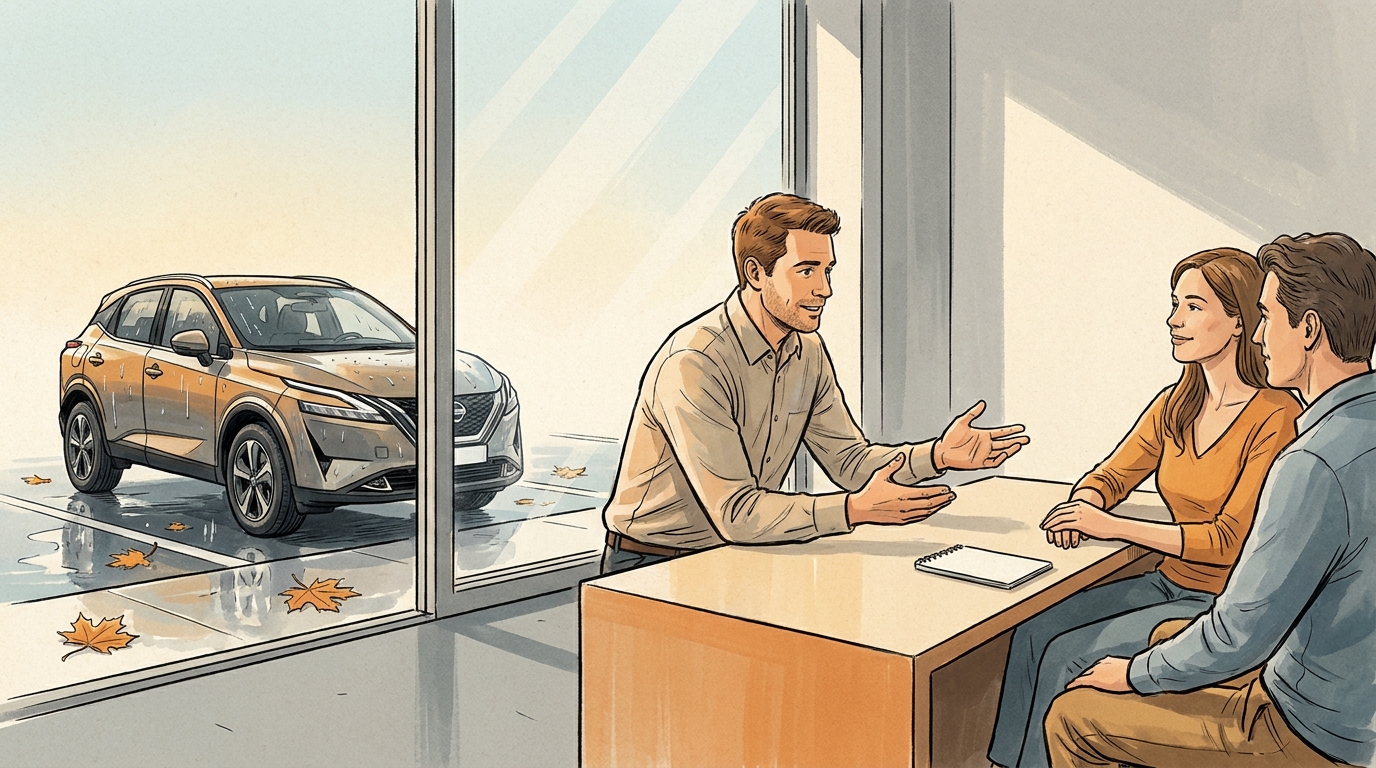
The finance office is the bridge between the sales floor and the paperwork that makes a vehicle legally yours. Once a buyer agrees on a vehicle and price with a salesperson, the deal is handed to an F&I manager who handles three core functions: arranging financing (or processing a cash deal), presenting optional insurance and protection products, and completing the legal paperwork required to title and register the vehicle.
At a typical Snohomish new car dealer, the F&I stage takes between 45 and 90 minutes. Much of that time is spent reviewing disclosures required by Washington law, verifying loan terms with lenders, and walking through the menu of protection products. Buyers who arrive prepared — with insurance information, identification, proof of income if needed, and a clear sense of their budget — can move through the process noticeably faster.
Financing: How the Dealership Arranges Your Loan
Dealerships in Snohomish typically work with a network of lenders that includes national banks, regional institutions, captive finance companies (like Nissan Motor Acceptance), and Pacific Northwest credit unions. Nissan of Everett's finance team works with a number of financial institutions and banks throughout the Edmonds and Marysville, WA area. When a buyer applies for financing through the dealership, the F&I office submits the application to multiple lenders simultaneously and presents back the strongest available offers.
This indirect lending model often produces competitive rates because lenders compete for the loan. However, buyers should always know their own credit score and, ideally, secure a pre-approval from their own bank or credit union before walking in. That outside offer becomes the benchmark against which any dealer-arranged financing should be measured.
Key Financing Terms to Verify
- APR (annual percentage rate) — the true cost of borrowing, including fees
- Term length — most loan terms fall between 48 and 72 months; longer terms reduce payments but increase total interest
- Down payment — affects monthly payment and loan-to-value ratio; financing with no down payment is available in most cases, and taxes, registration, and fees can often be rolled into the financing deal
- Total amount financed — the figure that should match the agreed vehicle price plus taxes, fees, and any added products
- Prepayment terms — Washington loans generally allow penalty-free early payoff, but the contract should be reviewed
Insurance Products Offered in the F&I Office
The protection products presented in F&I are optional. None are required to complete the purchase, and a buyer's decision to decline them cannot affect the vehicle price or financing terms. That said, several of these products provide genuine value for the right buyer — particularly in a market like Snohomish, where wet winters, road salt during freeze events on Highway 9 and US-2, and longer-than-average commutes can put real wear on a vehicle.
GAP Coverage
Guaranteed Asset Protection covers the difference between what a buyer owes on the loan and what the vehicle is worth if it is totaled or stolen. New vehicles depreciate quickly in the first two years, and buyers who finance with a small down payment can easily owe more than the insurance payout would cover. GAP is most relevant for buyers with loan-to-value ratios above 100 percent or terms longer than 60 months.
Vehicle Service Contracts (Extended Warranties)
A service contract extends mechanical coverage beyond the factory warranty. New Nissan vehicles come with factory warranty coverage, so extended service contracts matter most for buyers who plan to keep the vehicle past those windows. Coverage levels vary widely — from powertrain-only to bumper-to-bumper — and buyers should review the exclusions list, not just the marketing summary.
Tire and Wheel Protection
This product is more relevant in the Pacific Northwest than buyers might assume. The stretches of older pavement along the Snohomish River valley and the seasonal potholes that appear after winter freeze-thaw cycles routinely damage low-profile tires and alloy wheels. For buyers commuting from Snohomish into Everett or Seattle on aging surface roads, the math can pencil out.
Paint and Interior Protection
Given Snohomish's high annual rainfall, moss and mildew exposure, and the tree sap common in neighborhoods near Centennial Trail and Lord Hill Regional Park, paint and fabric protection have legitimate use cases. Buyers should compare dealer-applied products against aftermarket ceramic coatings before deciding.
Washington-Specific Paperwork and Tax Treatment
Several elements of the F&I process are specific to Washington state and to Snohomish County buyers. Understanding them in advance prevents surprises at signing.
Sales tax on trade-ins: Washington allows a trade-in tax credit. Buyers pay sales tax on the difference between the new vehicle's price and the trade-in value, not on the full purchase price. This can produce meaningful savings for buyers trading in a higher-value vehicle.
Local sales tax rates: Snohomish County applies a combined state and local sales tax that varies by the buyer's residence address, not the dealership location. The F&I office calculates the correct rate based on where the vehicle will be registered.
Registration and title: Washington vehicle registration is handled through the Department of Licensing. Dealers typically process initial registration and title work on the buyer's behalf, with fees disclosed in the buyer's order.
Required disclosures: Washington law requires specific disclosures around financing terms, optional product pricing, and any prior damage history on a new vehicle. The F&I manager is responsible for walking through these before signatures.
How to Prepare Before Walking In
Buyers who prepare for the F&I stage tend to have shorter, less stressful sessions. A short checklist:
- Pull a current credit report and know the score
- Secure at least one outside financing pre-approval as a benchmark
- Bring a valid Washington driver's license and proof of insurance
- Bring recent pay stubs or proof of income if financing
- Decide in advance which protection products are worth considering, and which are not
- Read every line of the buyer's order before signing — particularly the itemized fees and any added products
Frequently Asked Questions
Can a buyer negotiate F&I products?
Yes. Pricing on service contracts, GAP, and protection products is typically not fixed. Buyers can decline products outright, negotiate the price, or request to add a product later after researching alternatives.
Does declining F&I products affect the vehicle price?
No. The agreed vehicle price and approved financing terms are independent of any optional product decisions. If a buyer feels otherwise pressured, that is a sign to slow down and ask for the numbers in writing.
How long is the F&I appointment?
At a well-staffed Snohomish new car dealer, expect 45 to 90 minutes. Cash deals run shorter; financed deals with trade-ins and product reviews run longer.
Is dealership financing always more expensive?
Not necessarily. Dealer-arranged financing is often competitive, particularly when manufacturer incentives are available. The honest test is to compare the dealer's offer side-by-side with an outside pre-approval on identical terms.
Can taxes and registration fees be included in the loan?
Yes, in most cases. Washington buyers financing through a dealership can often roll taxes, registration, and fees directly into the loan rather than paying them out of pocket at signing. This affects the total amount financed, so buyers should factor it into their overall cost comparison when evaluating loan offers.
What happens to personal financial information submitted during the F&I process?
Washington dealers are required to handle buyer financial data according to state and federal privacy laws. Reputable dealerships do not sell or rent customer personal information to third parties without consent. Buyers should ask the F&I manager directly how their data is stored and shared before submitting a credit application.
Working With a Dealership That Explains the Process
The quality of an F&I experience varies enormously by dealership. Buyers in Snohomish consistently rate their experiences higher at stores where staff explain each document, present products without pressure, and answer questions plainly. Nissan of Everett holds a 4.4-star rating from more than 1,000 Google reviews as of April 2026, reflecting that approach. One customer wrote that the experience was "the best car shopping and buying experience I could ask for," noting that the salesperson "listened to what we had to say, understood our goals, and met us in the middle with options that fit our needs." Another described receiving "pure professionalism to the highest degree" from the moment of first contact.
For buyers in Snohomish who want to understand exactly what they are signing — and why — choosing a dealership that treats the F&I office as part of the customer experience rather than a separate sales pitch matters more than most shoppers realize.
Next Steps for Snohomish Buyers
The F&I office is where a vehicle purchase becomes a binding contract, which is why preparation and clarity matter so much at this stage. Buyers who understand financing structure, know which protection products fit their situation, and recognize Washington's tax and registration rules walk out with better deals and fewer surprises.
Residents of Snohomish who want to see this process handled transparently can contact Nissan of Everett at www.nissanofeverett.com or by phone at (425) 347-5763 to review inventory, request a financing pre-qualification, or schedule a visit to discuss options with the finance team directly.
"