Nissan EV Financing in Kirkland, WA: 2026 Buyer's Guide
How Nissan EV financing works for Kirkland buyers in 2026: loan structures, Washington tax rules, incentive stacking, and monthly payment expectations.
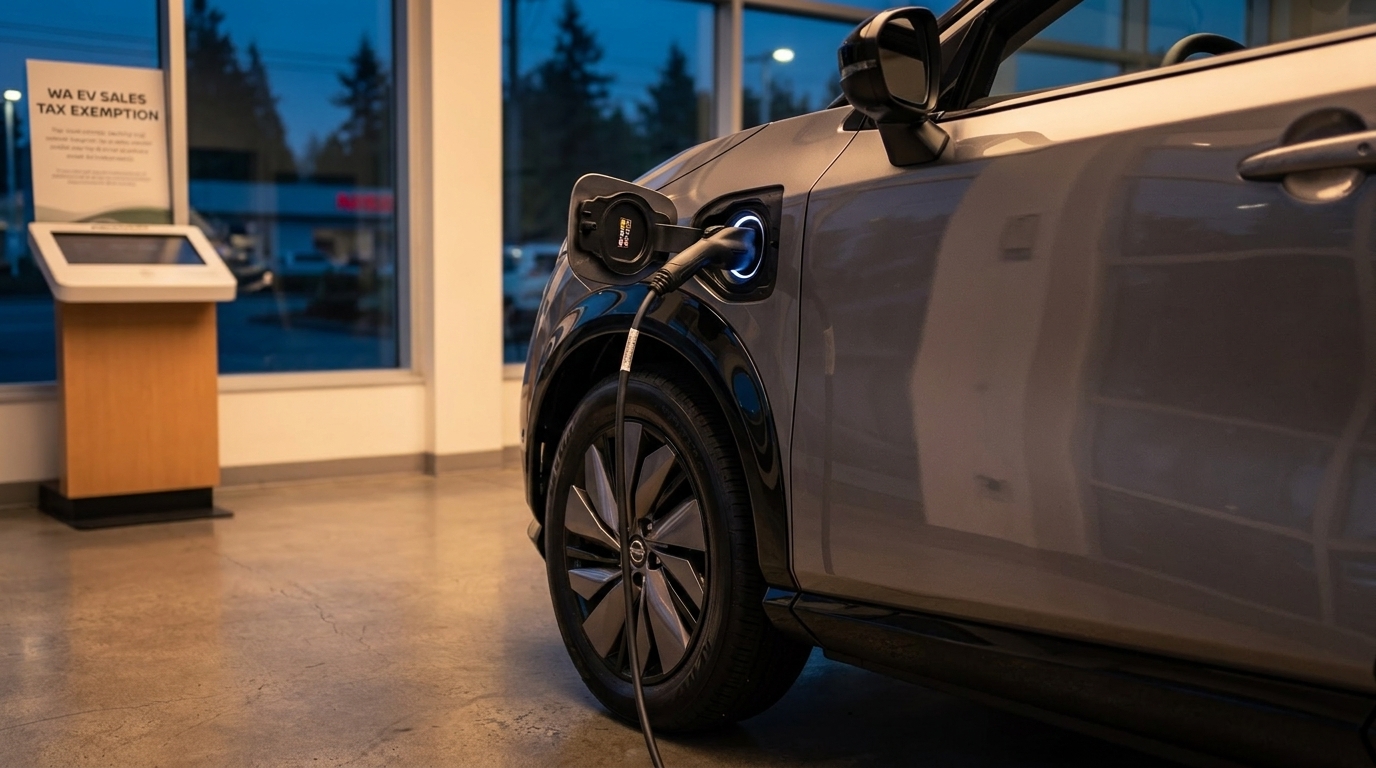
Kirkland buyers financing a Nissan EV in 2026 face a materially different math problem than they did a year ago., which means the upfront tax break most shoppers factored into their loan calculations is gone. What remains is a narrower use-tax exemption running through June 30, 2029, the federal clean vehicle credits under IRC §30D and §25E, and standard dealer financing subject to both federal Truth in Lending Act disclosures and Washington's Consumer Protection Act.
The practical result: monthly payments on a Nissan LEAF or Ariya in Kirkland now depend more on how a buyer structures the loan, stacks federal incentives, and negotiates the amount financed than on any single state tax break. Here is how the pieces fit together.
How Nissan EV Financing Is Structured in 2026
A Nissan EV loan in Kirkland is a standard retail installment contract — the same instrument used for gas vehicles — with the vehicle serving as collateral. The dealer either funds the loan directly or, more commonly, assigns it to a lender such as Nissan Motor Acceptance Company, a credit union, or a bank. Federal Regulation Z requires that before the contract is signed, the buyer receive written disclosure of the APR, total finance charge, amount financed, total of payments, and the payment schedule.
What changes with an EV is the inputs to that calculation, not the mechanics. The amount financed reflects the vehicle price, any dealer add-ons, taxes actually owed, and title and registration fees, minus the down payment, trade-in credit, and any incentives applied at point of sale. Because Washington's broad EV sales-tax exemption has sunset, the taxable base on most new Nissan EVs delivered today is the full negotiated price, which pushes the amount financed higher than comparable 2026 deals.
Which Washington Tax Rules Still Affect the Payment
Three Washington provisions still move the number on a Nissan EV loan, and one federal provision matters more than any of them.
- Use-tax exemption for qualifying plug-in vehicles (through June 30, 2029). Under RCW 82.12, as implemented by WAC 458-20-279 and 458-20-27901, clean alternative fuel and plug-in vehicles with at least 30 miles of electric-only range remain eligible for a use-tax exemption. This primarily matters for out-of-state purchases or private-party transactions where use tax, rather than retail sales tax, is the operative levy. Dealers must document vehicle type, price, and eligibility to apply the exemption at point of sale.
- Hydrogen fuel-cell exemption (through July 31, 2028). Not applicable to the current Nissan EV lineup, but relevant context: Washington now treats fuel-cell vehicles more favorably than battery EVs on tax, with a 50% use-tax exemption on new fuel-cell vehicles and a 100% exemption on used ones up to $16,000 in value.
- Commuter ride-sharing excise-tax exemption. Under RCW 82.44.015, passenger EVs seating 5 or 6 (including the driver) used in qualifying commuter ride-sharing for 36 consecutive months may be exempt from motor vehicle excise tax. For King County employers subject to commute trip reduction plans under RCW 70.94 — a category that includes many of the larger workplaces around Kirkland's Totem Lake and Carillon Point business districts — this can be a meaningful ownership-cost lever, though it does not directly reduce the loan.
The federal side is where most of the payment relief now sits. The IRC §30D new clean vehicle credit and the §25E used clean vehicle credit remain available to qualifying buyers regardless of Washington's state exemption status. The used credit is limited to vehicles priced at $25,000 or less, purchased from a licensed dealer, and subject to buyer income limits. For leased vehicles, the §30D credit accrues to the lessor rather than the consumer, though lessors commonly pass the value through as reduced lease payments.
Stacking Incentives Against the Amount Financed
The cleanest way to lower a Kirkland EV payment in 2026 is to apply the federal credit at the point of sale rather than waiting to claim it on a tax return. Under current IRS rules, eligible buyers can transfer the §30D or §25E credit to a registered dealer, which reduces the amount financed dollar for dollar. On a used Nissan LEAF that qualifies under §25E, that can mean up to $4,000 off the amount financed on day one — which, at typical current auto-loan APRs, translates into meaningful monthly savings across a 60- or 72-month term.
Manufacturer-side incentives from Nissan — APR subvention, bonus cash, loyalty and conquest rebates — stack on top of the federal credit. These change frequently and are program-specific, so buyers should confirm which offers are live at the time of purchase rather than relying on any figure quoted in a general article.
What Monthly Payments Actually Depend On
Four inputs drive a Kirkland Nissan EV payment more than anything else: the negotiated selling price, the APR (which is a function of credit tier, term, and any manufacturer subvention), the term length, and the size of the down payment plus trade-in equity. A longer term lowers the monthly payment but increases total finance charges disclosed under TILA; a larger down payment reduces both.
Because King County and City of Kirkland sales tax components apply to taxable EV sales now that the broad state exemption has expired, buyers should ask for a worksheet that separates the vehicle price, local tax, documentary fees, and any add-on products such as GAP insurance or extended service contracts. RCW 19.86.020 makes clear disclosure of these components enforceable as a consumer-protection matter, and a legitimate dealer will walk through each line rather than presenting only a monthly figure.
Financing Disclosures Kirkland Buyers Should Expect
Every Nissan EV financing contract signed in Kirkland must include a federal Truth in Lending disclosure box showing APR, finance charge, amount financed, total of payments, and payment schedule, delivered before consummation of the credit transaction. Washington layers on additional expectations: total cash price, itemized add-on costs, and any fees must be clearly presented, and failure to do so can be treated as an unfair or deceptive act under the state Consumer Protection Act.
Buyers should also receive a purchase order that identifies the vehicle, price, trade-in allowance, taxes, and fees consistent with Washington Department of Licensing dealer requirements under Title 46 RCW. Improper exemption claims are auditable by the Washington Department of Revenue, so paperwork accuracy protects both parties.
Frequently Asked Questions
Can Kirkland buyers still get a Washington sales-tax break on a new Nissan EV?
No — not the broad exemption that existed previously. A use-tax exemption for qualifying plug-in vehicles with at least 30 miles of electric-only range remains available through June 30, 2029, but it applies in narrower circumstances than the old sales-tax break.
Does the federal EV tax credit reduce the monthly payment directly?
It can, if the buyer transfers the credit to a registered dealer at point of sale. That reduces the amount financed, which lowers every subsequent monthly payment. If the buyer instead claims the credit on a tax return, the monthly payment is unaffected and the benefit arrives as a lump sum at tax time.
Do leased Nissan EVs qualify for the federal credit in Washington?
The credit goes to the lessor under §30D, not the consumer lessee. Lessors frequently pass some or all of that value through as reduced capitalized cost or lower monthly payments, but the pass-through is a commercial decision, not a legal requirement, so lease quotes should be compared on the total monthly and drive-off numbers.
What if a Kirkland buyer uses the EV for commuter ride-sharing?
A passenger EV seating 5 or 6 including the driver, used in qualifying commuter ride-sharing for 36 consecutive months, may be exempt from motor vehicle excise tax under RCW 82.44.015. The vehicle must be operated by a public transportation agency, a major employer, or registered individual employees in counties with commute trip reduction obligations under RCW 70.94.
The Bottom Line for Kirkland EV Shoppers
The Nissan EV financing math in Kirkland in 2026 rewards buyers who negotiate the selling price hard, apply the federal §30D or §25E credit at point of sale where eligible, and read the TILA disclosure box carefully before signing. Washington's remaining exemptions help at the margins, but the federal credit and the negotiated price are the two levers that move the payment most.
Kirkland shoppers who want a specific, itemized quote on a Nissan LEAF or Ariya — with the federal credit applied at point of sale, local tax broken out, and financing disclosures reviewed line by line — can reach Nissan of Everett at https://www.nissanofeverett.com to work through the numbers before committing to a term or lender.