Buy a New Nissan With Bad Credit in Everett, WA
How bad-credit buyers can finance a new Nissan near Everett, WA — subprime loan options, Washington disclosure rules, and what to bring to the dealership.
Buyers with damaged credit can typically finance a new Nissan near Everett through a dealership's subprime lender network, which pairs applications with lenders that specialize in low-FICO borrowers. Approval usually requires proof of income, proof of residence, a larger down payment, and acceptance of a higher APR than prime borrowers pay. Washington law does not impose a separate subprime disclosure regime, but every retail installment contract must disclose the APR, finance charge, amount financed, and total of payments in writing.
What does "bad credit" actually mean when financing a Nissan in Everett?
In auto lending, "bad credit" generally refers to FICO scores below roughly 620, a range lenders call subprime, and below 580 is often labeled deep subprime. Washington State does not create a separate subprime auto lending category, so the same Motor Vehicle Retail Installment Sales Act (RCW 63.14) and federal Truth in Lending Act rules apply regardless of a buyer's credit tier.
What changes with a lower score is not the legal framework but the lender pool. A dealership like Nissan of Everett routes lower-credit applications to lenders that price for elevated default risk — meaning higher APRs, shorter terms, and often a required down payment of 10% to 20% of the vehicle's price.
What financing options are actually available to low-credit buyers near Everett?
Low-credit buyers near Everett typically have four realistic paths: captive financing through Nissan Motor Acceptance Company, indirect financing through a dealer's subprime lender network, credit-union loans (often more forgiving on mid-tier credit), and Buy Here Pay Here lots (usually a last resort with the highest cost). A franchised Nissan dealership can access the first two directly.
Nissan of Everett, located along the Broadway auto corridor in Snohomish County, works with a network of lenders that includes both prime and subprime desks. That matters because a single application can be shopped to multiple lenders, increasing the odds of approval without the buyer submitting separate applications and taking multiple hard credit pulls in short succession.
Manufacturer-sponsored programs come and go, and Nissan periodically runs first-time buyer or recent-graduate programs that relax credit criteria in exchange for a co-signer or proof of steady income. Availability changes month to month, so current program eligibility should be confirmed with the dealership.
What does Washington law require the dealership to disclose?
Under Washington's Motor Vehicle Retail Installment Sales Act (RCW 63.14), every retail installment contract must be in writing and clearly state the cash price, down payment, unpaid balance, amount financed, finance charge, APR, total of payments, payment schedule, and any documentary service fees. Federal Regulation Z (12 CFR 1026) layers on the same core disclosures for consistency across states.
Washington also requires specific vehicle-condition disclosures under RCW 46.70.180 — branded titles (salvage, rebuilt, flood), substantial prior damage that could not reasonably have been discovered at trade-in, known odometer discrepancies, and prior business or government ownership on request. These apply to used inventory more than new, but any new-car shopper cross-shopping a used Nissan should know they exist.
One item Washington does not require: disclosure of the dealer's interest-rate markup (dealer reserve) over the lender's buy rate. That markup is legal, uncapped by state statute, and a legitimate topic to negotiate. Washington also does not give retail installment buyers a general cooling-off or cancellation right after signing — the contract disclosure under RCW 63.14.154 makes that lack of cancellation right explicit.
How much down payment and what APR should a subprime buyer expect?
Subprime auto APRs in the current market commonly run well above prime rates, and deep-subprime borrowers may see rates approaching state usury ceilings. Down payment expectations typically start at 10% for mid-tier subprime and climb to 20% or more for deep subprime, though a strong trade-in can substitute for cash down.
The following table outlines what buyers near Everett should generally expect. Exact terms depend on the lender, the vehicle, and the applicant's full profile.
| Credit Tier | FICO Range | Typical Down Payment | Common Term Length |
|---|---|---|---|
| Near-prime | 620–659 | 0–10% | 60–72 months |
| Subprime | 580–619 | 10–15% | 48–72 months |
| Deep subprime | Below 580 | 15–25%+ | 36–60 months |
| No credit / thin file | N/A | 10–20% or co-signer | 48–72 months |
What should a bad-credit buyer bring to the dealership?
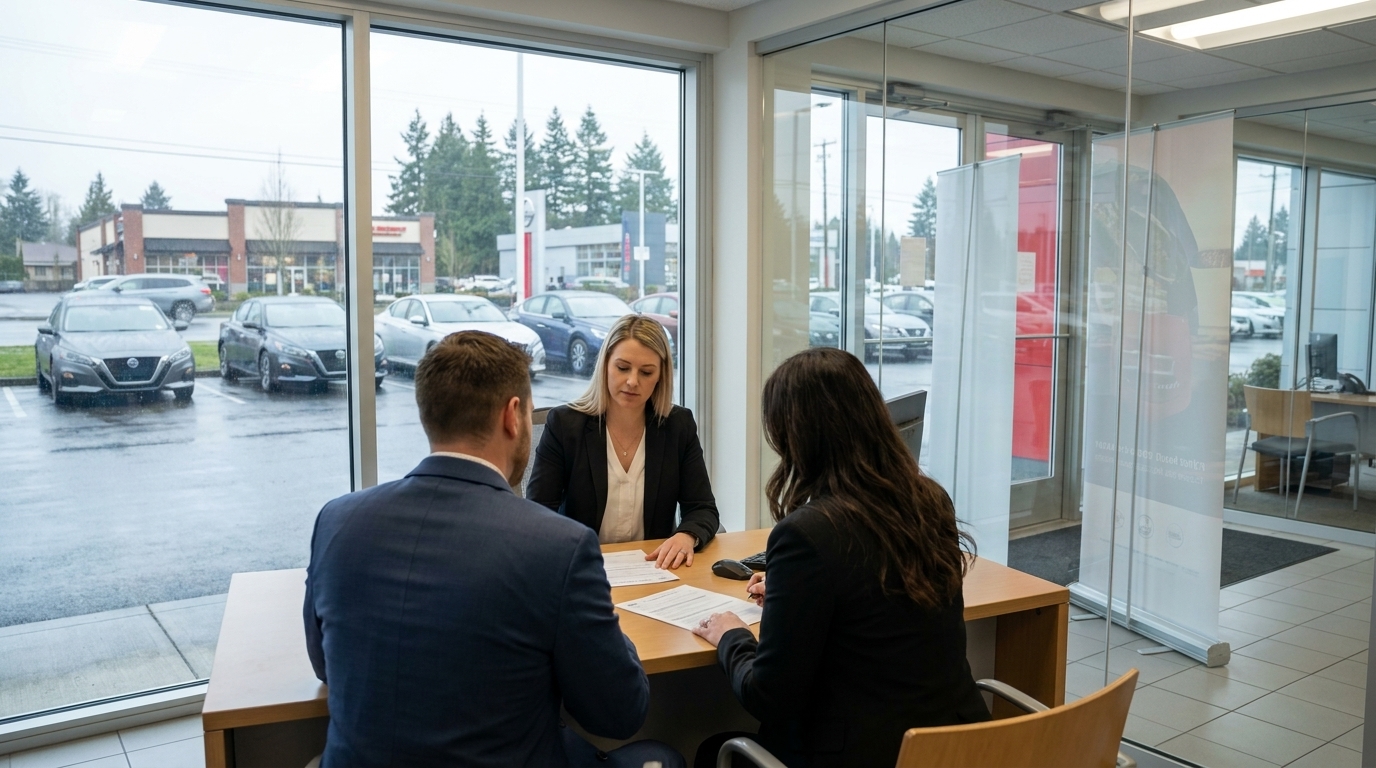
Subprime lenders verify more than prime lenders do, so preparation shortens the approval cycle materially. Buyers should arrive with a valid Washington driver's license, two recent pay stubs (or three months of bank statements for self-employed applicants), proof of Everett-area residence such as a utility bill, proof of full-coverage insurance, and a list of references with phone numbers.
A meaningful down payment — cash, trade equity, or a combination — is the single strongest lever a low-credit buyer controls. It reduces the loan-to-value ratio the lender is underwriting, which often moves an application from decline to approval or lowers the offered rate.
How does the delivery-before-financing rule protect Everett buyers?
Under RCW 46.70.180(4)(a), when a Washington dealer delivers a vehicle before financing is finalized, the dealer has a 4-day window to secure lender approval on the agreed terms. This provision limits the deceptive practice known as yo-yo financing, in which a buyer is called back days or weeks later and pressured into worse terms.
Buyers who accept delivery on a spot-delivery or conditional-delivery basis should keep every document from the transaction and know that a call for "new paperwork" after the 4-day window carries different legal weight than a call within it. When in doubt, consumers can contact the Washington Attorney General's office, which enforces the Consumer Protection Act (RCW 19.86) against unfair or deceptive auto-lending practices.
How does Nissan of Everett approach low-credit buyers?
Nissan of Everett has received customer feedback praising sales staff who listen and present options rather than push a single deal. That consultative approach matters more, not less, when a buyer's credit limits the number of viable structures.
For Snohomish County shoppers who commute on I-5 or work in the Boeing Everett corridor, having a franchised Nissan dealer that runs applications through multiple lenders in one sitting reduces the friction of shopping subprime credit — and reduces the number of hard inquiries hitting an already-thin credit file.
Frequently asked questions
Can someone with a 500 credit score buy a new Nissan in Everett?
It is possible but difficult. Deep-subprime applicants (below 580 FICO) usually need a substantial down payment of 15% to 25%, verifiable income sufficient to support the monthly payment, and often a co-signer. A used or certified pre-owned Nissan is frequently a more realistic path to approval than a new model for buyers in the 500 range.
Does Washington cap the interest rate on subprime auto loans?
Washington's Motor Vehicle Retail Installment Sales Act (RCW 63.14) governs finance-charge structure for retail installment contracts, but the state does not impose a special subprime-specific rate cap or require disclosure of the dealer's markup over the lender's buy rate. Federal law under TILA requires the APR itself to be clearly disclosed in the contract before signing.
Will applying at a Nissan dealer hurt my credit score?
A single application typically generates one hard inquiry, which can lower a FICO score by a few points temporarily. When a dealer shops one application across multiple lenders within a short window, those inquiries are often treated as a single event for auto-loan shopping purposes, minimizing the impact.
Can I return a Nissan in Washington if I change my mind after signing?
No. Washington law does not give retail installment auto buyers a general cooling-off or cancellation right after a contract is finalized, and RCW 63.14.154 requires the contract to state this plainly. The narrow exception is conditional delivery: if financing has not been finalized, the 4-day approval window under RCW 46.70.180(4)(a) applies and can trigger unwind rights if the deal cannot be funded on the agreed terms.
Is a co-signer required for subprime Nissan financing?
Not always, but a qualified co-signer significantly improves approval odds and pricing for buyers with limited or damaged credit. The co-signer takes on full legal responsibility for the loan, so both parties should understand that missed payments will damage both credit files. Some manufacturer first-time buyer programs specifically use co-signers as a substitute for credit history.
What documents do subprime lenders require that prime lenders don't?
Subprime lenders typically want stronger verification: additional pay stubs, proof of residence, personal references, a working phone in the applicant's name, and sometimes proof that utilities are paid current. Self-employed applicants often need to provide tax returns or several months of business bank statements rather than pay stubs.
Next steps for Everett buyers
Bad credit narrows financing options but rarely closes them entirely, especially at a franchised dealership with access to multiple lender relationships. Buyers who arrive prepared — with income documentation, a realistic down payment, and clear expectations about APR and term — routinely leave with financing that fits their budget.
Readers in Everett, WA who want to explore new Nissan financing with a low credit score can reach Nissan of Everett at https://www.nissanofeverett.com to review inventory, start a credit application, and discuss which lender programs currently fit their situation.